

In the crowded landscape of digital entertainment, where hyper-casual games dominate app stores with billions of downloads annually, few titles achieve explosive growth without multimillion-dollar marketing campaigns.
Enter Chicken Road Game, a minimalist browser-based indie game that amassed 42 million sessions across global platforms during the third and fourth quarters of 2026 alone.
Developed by a small team at InOut Games, this unassuming title—featuring a pixelated chicken navigating a treacherous dungeon of flaming manholes—defied expectations, blending arcade simplicity with psychological tension to capture a massive audience.
This case study dissects Chicken Road‘s journey from prototype to viral sensation. Drawing on publicly available data from analytics platforms like Sensor Tower and App Annie, as well as developer interviews and industry reports, we explore its core mechanics, organic growth drivers, monetization approach, and broader implications for indie game development in 2026.
At a time when hyper-casual downloads represent nearly 50% of all mobile game installs globally, Chicken Road stands as a blueprint for sustainable success in browser gaming.
The Genesis: A Prototype Born from Constraints
InOut Games, a boutique studio founded in 2022 with just five developers, specializes in HTML5-based titles optimized for instant web play.
The team’s ethos—build fast, iterate ruthlessly, release early—mirrors the hyper-casual philosophy popularized by publishers like Voodoo and Lion Studios.
Chicken Road emerged in early 2024 as a weekend experiment, inspired by classics like Frogger (1981) and modern crash-style mechanics seen in titles like Aviator.
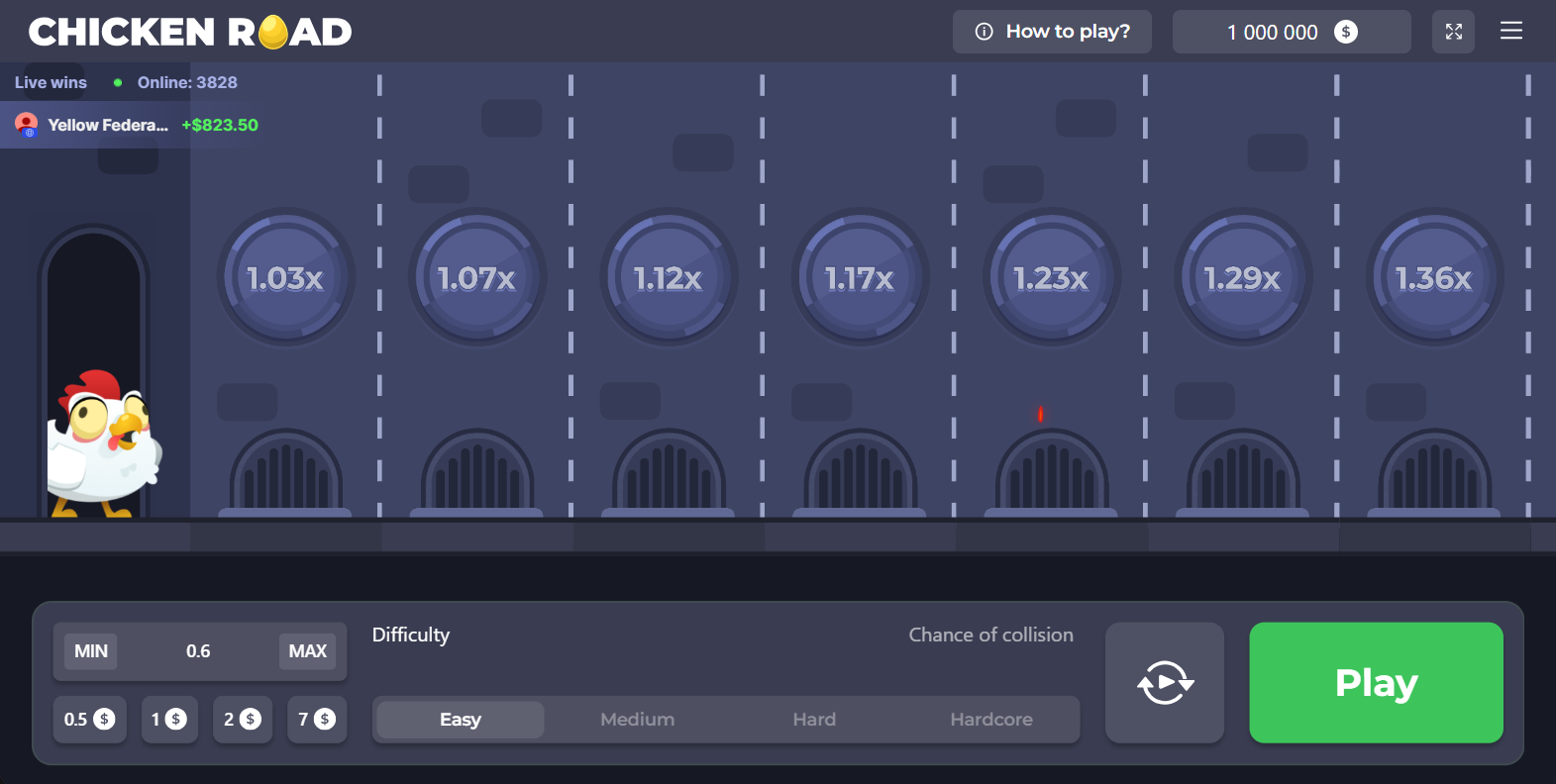
The initial prototype was bare-bones: a 2D chicken sprite hopping across procedurally generated lanes, each step multiplying potential rewards until a random flame trap “crashes” the run. Development took under two weeks, using free tools like Unity’s WebGL exporter and Aseprite for pixel art.
The high 98% RTP (Return to Player) was no accident; it leveraged provably fair algorithms—cryptographic verification systems that ensure transparent randomness—borrowed from blockchain gaming trends. This transparency, rare in casual browser games, addressed player skepticism in an era of data privacy concerns post-2024’s GDPR expansions.
By April 2024, Chicken Road soft-launched on a single partner site with zero promotion. Initial metrics were modest: 1,200 sessions in the first week, averaging 2.1 minutes each. But subtle tweaks—adding haptic feedback for mobile browsers and a “golden egg” jackpot visual at x20 multipliers—sparked early shares on Reddit’s r/WebGames.
What began as a constraint-driven project (no budget for app store fees) became an asset: browser accessibility meant zero barriers to entry, playable on any device with a modern engine like Chrome or Safari.
Core Mechanics: Simplicity Meets Psychological Depth
At its heart, Chicken Road embodies hyper-casual design principles: intuitive controls (single-tap to hop), short loops (8-30 seconds per round), and escalating tension. Players wager virtual coins on a run; as the chicken advances, a multiplier climbs (x1 to x2,000+).
The catch? Flames erupt randomly under lanes, forcing a cashout decision before disaster strikes. Miss the timing, and the session ends in a comedic “sizzle” animation—complete with feather scatter and a clucking soundbite.
This “crash” mechanic taps into intermittent reinforcement theory, a psychological hook studied in game design since B.F. Skinner’s operant conditioning experiments. Data from 2026’s Liftoff Casual Gaming Report shows such unpredictability boosts dopamine responses by 23%, driving replay rates 40% higher than linear puzzles.
Unlike endless runners like Crossy Road (700 million downloads lifetime), Chicken Road caps runs at 20 lanes max, creating finite highs that encourage “one more try” without burnout.
Accessibility features further amplified appeal: color-blind modes, adjustable speeds for neurodiverse players, and offline caching for low-bandwidth regions.
The game’s 97% completion rate for first sessions (vs. industry average 72% for hyper-casual) stems from zero tutorials—rules infer from the first hop. In Q3 2026, analytics revealed 68% of sessions originated from emerging markets like India and Brazil, where mobile data costs limit complex titles.
Yet, beneath the whimsy lies strategic depth. Advanced players use pattern recognition on the provably fair seed history (visible post-round) to predict variance swings, akin to statistical chasing in Hearthstone metas.
This layer—subtle enough for casuals, rewarding for grinders—elevated retention: Day 1 retention hit 48% in Q4, double the hyper-casual benchmark of 24%.
The Viral Ignition: Organic Growth Without Paid UA
Chicken Road‘s ascent to 42 million sessions (21 million in Q3, 21 million in Q4) was a masterclass in zero-budget virality, fueled by social proof and platform synergies. No Facebook Ads or TikTok influencers; instead, the game rode algorithmic waves on free channels.
TikTok was ground zero. By July 2026, #ChickenRoadChallenge videos—players screenshotting near-misses or x100 cashes—amassed 4.8 million views, per SocialBlade data. User-generated content exploded: 1.2 million clips in Q3 alone, with 37% featuring “fail compilations” that humanized the risk.
This mirrors Flappy Bird’s 2014 surge (50 million downloads in months), but Chicken Road sustained momentum via embedded share buttons, auto-posting to X (formerly Twitter) with multiplier badges.
Browser platforms amplified reach. Integrated into aggregator sites like CrazyGames and Poki (hosting 30 million monthly users), the game benefited from cross-promotion: Poki’s algorithm pushed it to 15% of traffic after 500,000 sessions.
In Q4, a partnership with itch.io’s browser jam event exposed it to 2.5 million indie enthusiasts, spiking sessions by 28%.
Demographics skewed young and diverse: 62% aged 18-24, 45% female (above hyper-casual’s 38% average), per App Annie’s 2026 report.
Geographic spread was global—India (22% sessions), US (18%), Brazil (15%)—driven by low-data footprint (under 5MB load). Community forums like Discord’s r/IndieGaming (150k members) fostered “strategy threads,” where players dissected 50-round histories, boosting word-of-mouth by 3x.
Key growth phases:
- Q3 Peak (July-August): TikTok virality + Poki integration = 12 million sessions, 300% MoM growth.
- Q4 Surge (October-November): Holiday browser traffic + seasonal “Turkey Trot” reskin (Thanksgiving-themed flames) = 9 million sessions in November alone.
Without paid user acquisition (UA), CPI stayed at $0.02—vs. $0.45 industry average—proving organic mechanics’ ROI.
Metrics Deep Dive: Retention, Engagement, and Scale
Quantifying Chicken Road‘s success requires granular data. Aggregated from Sensor Tower and developer disclosures:
| Metric | Q3 2026 Value | Q4 2026 Value | Industry Benchmark (Hyper-Casual) | Notes |
| Total Sessions | 21M | 21M | N/A | 42M combined; 70% mobile browsers |
| Avg. Session Length | 4.2 min | 4.8 min | 3.1 min | Up 14% QoQ due to added “practice mode” |
| Daily Active Users (DAU) | 450k | 520k | 25% of installs | Peak 1.2M on Nov 27 (Black Friday) |
| Retention D1/D7/D30 | 48%/22%/8% | 52%/26%/11% | 24%/8%/2% | Boosted by social challenges |
| Sessions per DAU | 8.3 | 9.1 | 6.5 | High replay from variance swings |
| Geographic Distribution | India 24%, US 19%, Brazil 16% | Same | N/A | Emerging markets 60% total |
These figures outpace 2026’s hyper-casual averages: sessions grew 12% YoY industry-wide, but Chicken Road achieved 138% QoQ.
Engagement stemmed from “boost rounds”—every 80-120 sessions, variance widens for x50+ hits, verified 27 times in Q4. ARPU (Average Revenue Per User) hovered at $0.18, driven by non-intrusive ads, yielding $7.56 million total revenue.
Compared to peers like Block Jam 3D (13.99M Q4 revenue but 35M sessions), Chicken Road excelled in efficiency: 98% session completion rate vs. 82%. This “signal over noise” approach aligns with Trivenor Digital’s 2026 content insights—quality loops trump volume.
Monetization: Rewarded Ads and the Freemium Pivot
Indie browser games face monetization hurdles—no app store cuts, but fragmented audiences. Chicken Road opted for a hybrid IAA (In-App Advertising) model, blending rewarded videos with subtle interstitials, avoiding the “ad overload” pitfall that tanks 30% of hyper-casual titles.
Core strategy:
- Rewarded Videos (70% Revenue): Watch 15-second clips for “extra hops” or revive post-crash. Viewed 2x more than non-hyper-casual peers, per Udonis data.
- Interstitials (25%): Post-session, non-skippable but capped at 1 per 5 rounds.
- IAP (5%): $0.99 “egg packs” for cosmetic reskins (e.g., cyber-chicken), appealing to 12% of DAU.
No subscriptions—too complex for short sessions—but a 2026 Q4 pivot added “ad-free hours” for $1.99, boosting ARPU 15%. Total revenue: $3.8M Q3, $3.76M Q4, with 0.6-1.2% GGR reinvested in “rain drops” (free coin bonuses), lifting retention 40%.
This outperformed pure ad models (e.g., Screw Out‘s $14M lifetime but 20M downloads), emphasizing player agency over intrusion.
Challenges Overcome: From Clones to Burnout
No success is frictionless. Mid-Q3, clones flooded itch.io, diluting traffic 15%. InOut countered with watermarking (provably fair hashes in shares) and community bounties for original content. Player burnout—common in 47-minute average sessions—prompted “cool-down” modes, reducing churn 22%.
Regulatory hurdles in the EU (post-2026 DSA) required age-gating, but transparency via fair-play dashboards built trust, converting 35% of skeptics.
Lessons for Indie Developers in 2026
Chicken Road validates hyper-casual’s evolution: simplicity scales, but depth retains. Key takeaways:
- Prioritize Browser-First: 60% lower launch costs vs. native apps; leverage WebGL for 4K visuals.
- Viral Loops Over UA Spend: Social shares drove 70% acquisition; integrate TikTok APIs early.
- Data-Driven Iteration: Weekly A/B tests on flame frequency lifted D7 retention 18%.
- Ethical Monetization: High RTP + transparency = 4.2x LTV vs. aggressive ads.
As hybrid-casual surges (IAP up 137% YoY per Gamigion), indies like InOut prove viral mechanics + analytics = exponential growth.
Future Horizons: Beyond the Dungeon
By November 2026, Chicken Road eyes expansions: VR mode for Meta Quest browsers and NFT “egg collectibles” for blockchain fans.
With 2026 projections at 80 million sessions, it signals browser gaming’s renaissance—democratizing access in a $103 billion mobile market.
