

Data-driven players are those who base their choices on actual data rather than emotions or conjecture. Every action they do, including trade, case opening, economy management, and gameplay, is guided by statistics, trends, and quantifiable outcomes.
To determine their next course of action, they examine damage charts, ROI trends, price histories, opponent economy cycles, and even their own performance heatmaps rather than depending solely on intuition.
These players have one fundamental characteristic in common, regardless of the area of the CS2 ecosystem they concentrate on. Because they constantly advance or make money via analysis, tracking, and well-considered choices rather than feelings.
Why Track ROI?
In CS2, tracking ROI essentially prevents you from trading blind. Prices move so often that without ROI, you can’t tell if your inventory is increasing or if you’re gradually losing money.
It makes it easier to identify which skins are dead weight, which ones are only “hot” because everyone is talking about them, and which skins genuinely climb over time. You can see exactly what is, ROI maintains the integrity of your trading. It indicates whether or not you are acting effectively.
You record the amount you spent on a skin, periodically verify its pricing, and determine how much it increased or decreased.
To get a complete view, the majority look at third-party costs. Some even use volume to determine whether the skin is “alive” or barely selling. You can already spot trends after a week or two, gradually.
How to Track ROI?
If you want to track ROI like a data-driven CS2 trader, the first step is simply recording what you bought and what you paid. Let’s say you pick up 5 AWP | Atheris at $3.00 each. You write down the price, the quantity, and the final cost after fees, because Steam cuts always matter.
Then, over the next days or weeks, you open Steam or a third-party site and check how the price moves. Maybe the Atheris climbs to $3.45, or maybe it dips to $2.90.
If you see it slowly rising across multiple days, that’s steady growth; if it jumps up overnight after a patch or a streamer showcased it, that’s hype. All you’re doing is watching the trend smooth rise, sudden spike, or slow bleed, so you know what direction your investment is actually going.
Once you have those numbers, calculating ROI becomes super easy. You take the current price and subtract your buy price, then divide by the buy price. So if your Atheris is now $3.45, the formula looks like this: (3.45 – 3.00) ÷ 3.00 = 0.15, meaning 15% ROI.
But the real skill comes from comparing these results with your other picks. Maybe your Atheris is up 15%, but the Five-SeveN | Boost Protocol you bought grew 28%, while a case you stacked barely moved at all.
After a month of tracking like this, you’ll already see which types of items climb steadily, which react strongly to updates, and which ones are basically dead weight. That’s how data-driven traders decide what to keep buying, what to stack, and what to never touch again; the numbers tell the story for them.
CS2 Case Opening Simulator for ROI Tracking
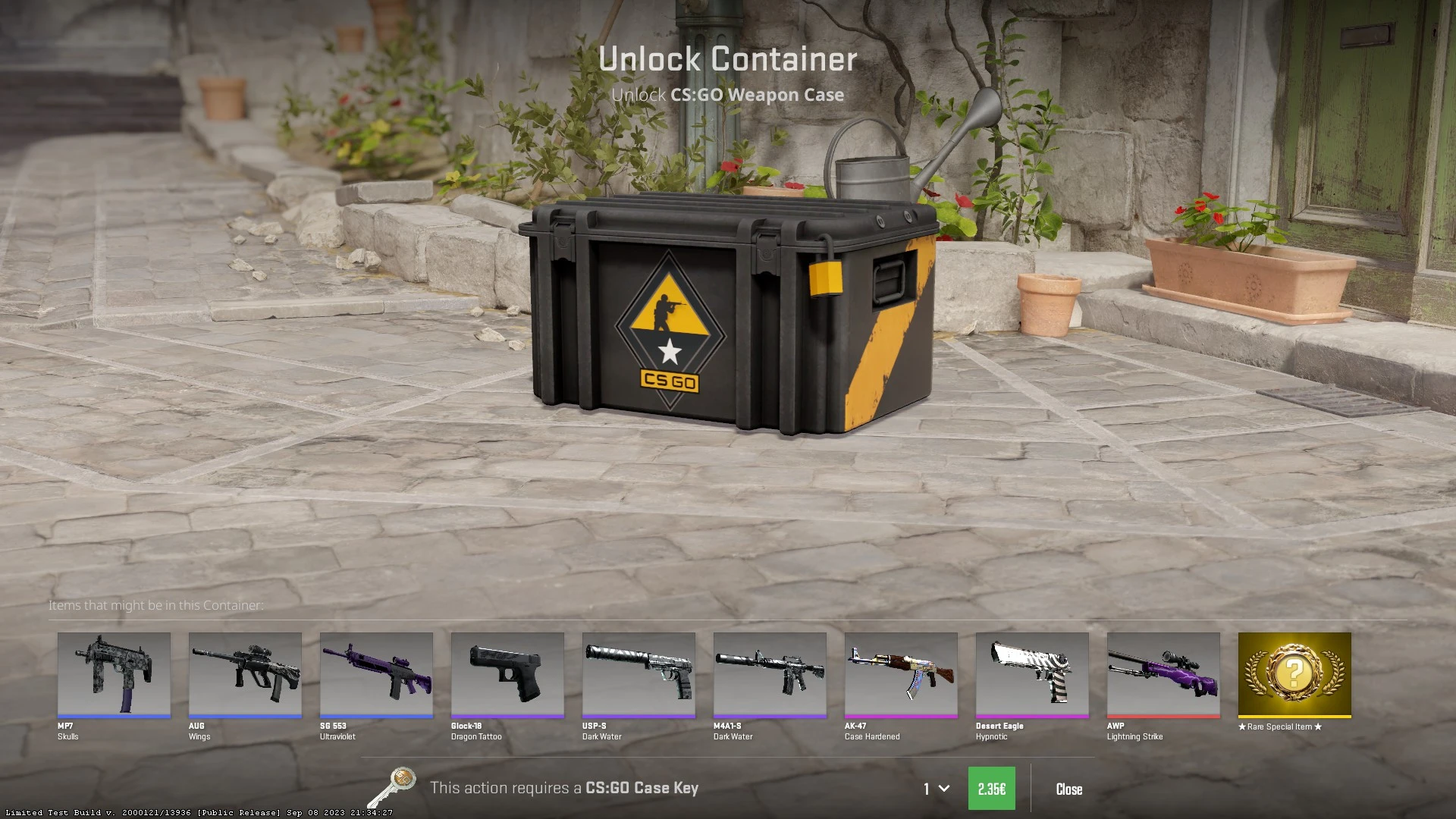
A CS2 box opening simulator can actually help with ROI way more than people expect, and not because it guarantees profit, but because it shows you how the odds really behave without burning your money on actual cases.
Giving you an idea of expected value is the primary function of a simulator. If you run a case 100, 500, or even 1,000 times and it continues to give you low-tier blues and purples, you should know that it has a poor long-term return on investment and that opening it for profit makes no sense.
However, you discover that the expected value is closer to break-even if a new case or a well-known community case regularly hits respectable mids and rare high-tier drops. Even while you won’t become wealthy from it, you will at least be aware of the cases that won’t immediately deplete your funds.
Simulators also help you compare cases side by side. Maybe two cases cost the same, but one actually spits out usable skins while the other is a bottomless pit.
Running a few long tests shows you which case has the better drop spread, and that translates directly into smarter spending on real sites.
How to Make ROI Profitable?
Keeping your ROI stable right now is basically about not fighting the new market. So the easiest way to stay profitable is to stick with skins that clearly look better now. You don’t need charts for that, you just open the game, spin the weapon around, and trust your eyes.
If it looks like it got a glow-up, chances are the market agrees. And volume matters even more now, so don’t waste time on rare skins nobody buys. High-volume mid-tier skins are the safe zone; they move daily and don’t crash out of nowhere.
Conclusion
In conclusion, the CS2 market became far more predictable than most people realize following the upgrades, but in a different way. Data-driven gamers have already discovered that timing, volume, and graphics are the three key components of the new economy.
If you also want to check, simply launch the game, observe how a skin seems right now, determine whether people are genuinely purchasing it, and avoid joining in as soon as something becomes popular.
