

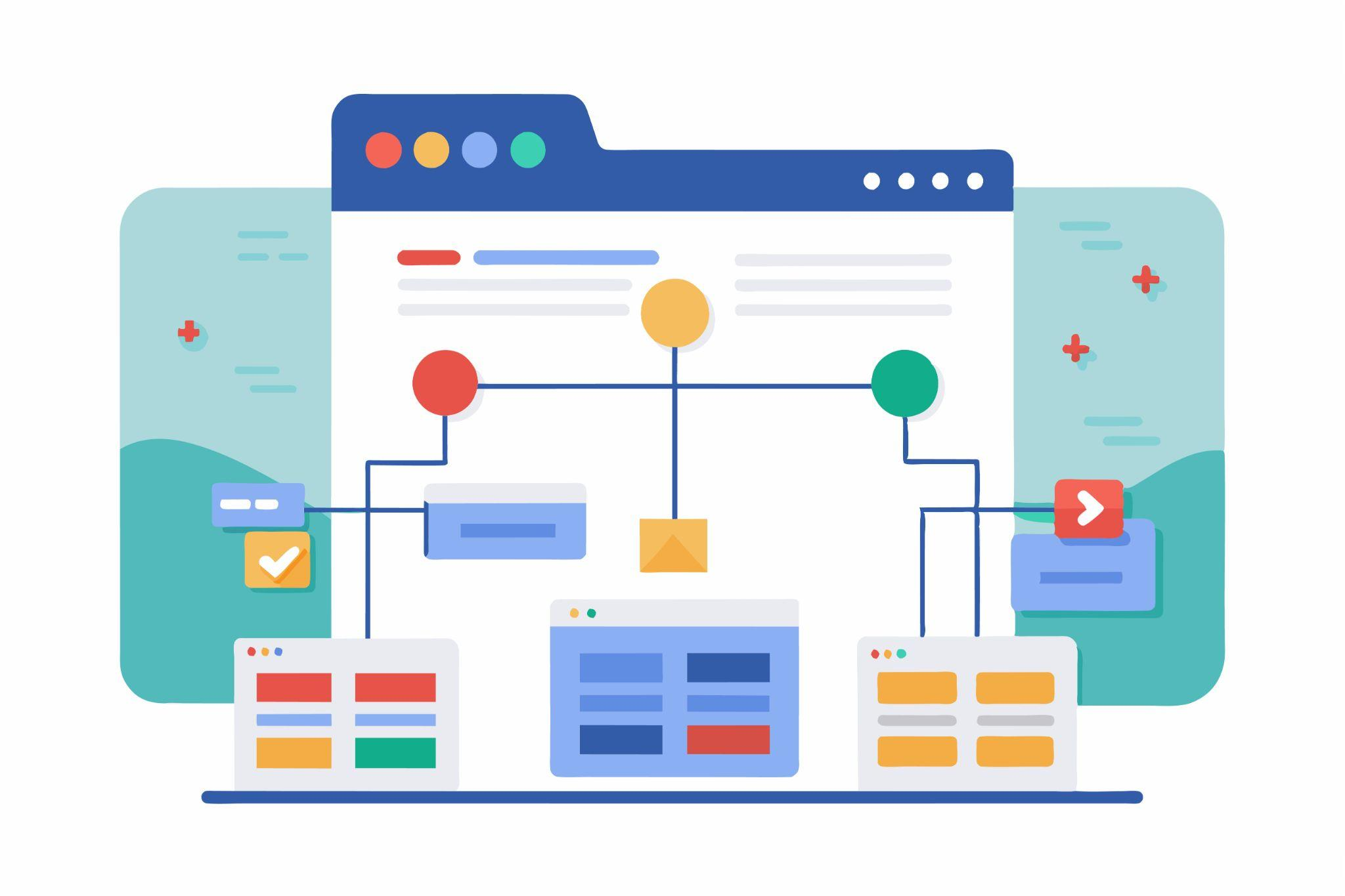
The Assumption Behind Website Growth
There’s a common assumption in digital marketing that more pages automatically lead to better results. More pages mean more keywords, more opportunities to rank, and more ways for potential customers to find a business. On the surface, it sounds logical. Growth, after all, often looks like expansion.
So businesses begin adding pages. New services get their own sections. Slight variations of existing offerings become standalone pages. Blog posts accumulate. Landing pages multiply. Over time, the website grows – sometimes significantly.
But growth in size does not always translate to growth in performance.
In many cases, the opposite happens. As more pages are added, websites become harder to manage, harder to navigate, and less effective at communicating what the business actually does. Instead of becoming stronger, the website becomes fragmented.
This is where a shift in thinking becomes important. A better website is not defined by how many pages it has, but by how well those pages work together.
The Misconception: Growth Through Expansion
Most businesses don’t intentionally create bloated websites. It happens gradually.
A new service is introduced, so it gets its own page. A marketing idea leads to a new landing page. Someone suggests targeting a specific keyword, so another page is created. None of these decisions are wrong on their own. In fact, they often make sense in isolation.
The problem is what happens when these decisions stack over time without a clear structure guiding them.
The underlying belief is that more pages equal more opportunities. More pages to rank. More pages to capture traffic. More pages to convert visitors. But this way of thinking treats a website like a collection of independent assets rather than a connected system.
When every new idea results in a new page, the website starts expanding outward without direction. Instead of building depth, it builds spread. And that spread can weaken the overall effectiveness of the website.
When More Pages Start to Work Against You
As a website grows without a clear structure, certain patterns begin to appear.
Information becomes scattered across multiple pages. Similar topics are covered in slightly different ways. Messaging becomes inconsistent depending on which page a visitor lands on. Instead of reinforcing each other, pages begin to compete.
For example, a business might have multiple pages targeting similar services with only minor differences. To the business, each page represents a new opportunity. But to a visitor, it can feel repetitive or unclear. Which page is the most important? Which one best represents what the business actually offers?
From a structural standpoint, this creates friction. Instead of guiding users through a clear journey, the website presents multiple parallel paths with no clear hierarchy.
Over time, this fragmentation reduces the overall strength of the website. Each page carries less weight because the focus is split. The website begins to feel larger, but not stronger.
The Hidden SEO Problem: Dilution Over Depth
From an SEO perspective, more pages are not inherently beneficial. What matters is how effectively each page serves a clear purpose.
When too many pages are created without a strong reason behind them, content often becomes thinner. Instead of building comprehensive resources, information is divided across multiple pages that individually lack depth.
This leads to a form of dilution.
Rather than having one strong page that clearly signals relevance and authority on a topic, the website ends up with several weaker pages competing for the same space. Search engines are then left to interpret which page is most relevant, and in many cases, none of them stand out.
Stronger websites tend to do the opposite. They consolidate information. They build depth within key pages. They make it clear what each page is meant to represent.
The result is not just better rankings, but clearer signals overall.
Depth creates strength. Spread often creates ambiguity.
Maintenance Becomes a Long-Term Liability
Adding pages doesn’t just affect performance in the short term. It also introduces long-term complexity.
Every page on a website needs to be maintained. Information changes. Services evolve. Messaging is refined. As the number of pages increases, the effort required to keep everything accurate grows significantly.
A simple update that could have been made in one place now needs to be made across several pages. Small inconsistencies begin to appear. One page reflects the current state of the business, while another still contains outdated details.
Over time, this creates a disconnect within the website itself.
What was once a clean, cohesive presence becomes harder to manage. Changes slow down. Errors become more common. The website starts to feel less reliable, not because the business has changed, but because the structure no longer supports it.
More Pages Can Fragment the User Experience
Visitors do not experience a website the way it is built internally.
They don’t see a sitemap. They don’t think in terms of page counts. They are simply trying to find information quickly and understand what a business offers.
When a website contains too many pages, especially without a clear structure, navigation becomes less intuitive. Users may find themselves clicking through multiple pages to piece together a basic understanding.
This creates unnecessary effort.
Instead of moving through a clear, guided experience, visitors are forced to navigate a fragmented system. Important information may be split across multiple pages, requiring extra steps to fully understand what the business does.
A more focused website reduces this friction. It presents information in a way that feels complete without requiring excessive navigation. It allows users to move forward with confidence, rather than piecing things together.
The Shift Toward Fewer, More Intentional Pages
High-performing websites tend to take a different approach.
Rather than continuously adding new pages, they focus on strengthening the pages they already have.
This shift is often misunderstood. As Sam Mendelsohn of Mendel Sites explains, “When a website lacks depth, adding more pages doesn’t solve the problem – it just spreads it across more places”
That is why stronger websites focus less on expansion and more on improving what already exists. Each page has a clearer role, content is consolidated where it makes sense, and the overall structure becomes easier to understand and maintain. Instead of expanding outward, the website becomes more refined.
When More Pages Actually Make Sense
It’s important to clarify that more pages are not inherently a problem.
There are many situations where expanding a website is the right decision. When a business offers clearly distinct services, targets different audiences, or operates in multiple service areas, additional pages can provide meaningful value.
The difference lies in intent.
When new pages are created with a clear purpose, they contribute to the overall strength of the website. They support specific goals. They fit within a larger structure. They add clarity rather than complexity.
The issue arises when pages are created reactively. When expansion is driven by assumptions rather than strategy. When each new page exists in isolation rather than as part of a cohesive system.
Intentional expansion strengthens a website. Reactive expansion weakens it.
Rethinking What Makes a Strong Website
More pages can give the impression of growth. A larger website feels more substantial. It feels like progress.
But in practice, more pages often introduce complexity rather than clarity. They dilute focus, increase maintenance, and fragment the user experience. What begins as expansion can quietly become inefficiency.
Strong websites are not built by continuously adding more. They are built by refining what already exists, ensuring that each page serves a clear purpose, and structuring content in a way that supports both users and long-term performance.
In the end, the goal is not to have more pages. It is to have better ones.
