

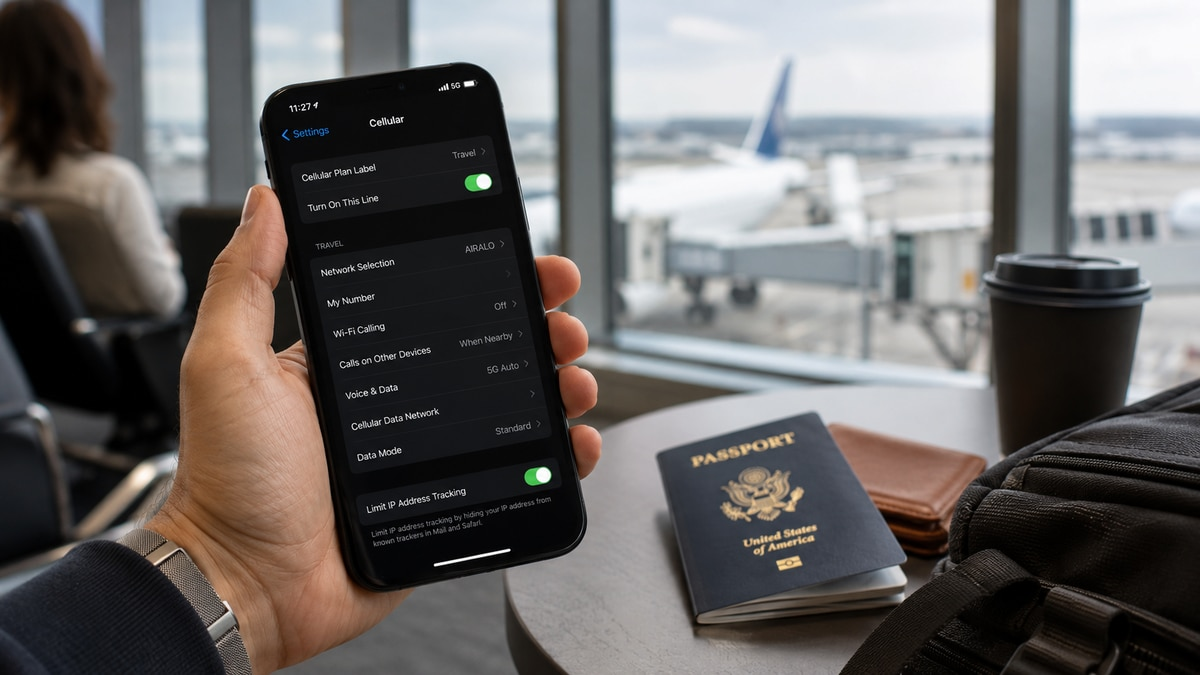
Picture this. You land in Tokyo after a fourteen-hour flight. Jet-lagged, slightly disoriented, you tap your phone to open Google Maps and find your hotel. Nothing. No signal.
Your carrier charges $12 per day for international roaming, and you forgot to activate the plan before takeoff. You spend the next forty minutes hunting for airport Wi-Fi and queuing at a SIM card kiosk staffed by someone who does not speak your language.
This scenario played out millions of times in 2025. In 2026, it is completely avoidable. The rise of eSIM technology has fundamentally rewritten the rules of staying connected abroad. Cheaper than carrier roaming by a factor of ten. Faster to activate than buying a local SIM.
And invisible in your pocket because there is nothing physical to insert. Here is everything digital travelers need to know to leave roaming behind for good.
What exactly is an eSIM, and why is it different?
An eSIM (embedded SIM) is a small chip soldered directly into your phone’s motherboard. Instead of inserting a physical card, you download a digital profile from a provider, scan a QR code or enter an activation code, and your phone starts using the new carrier within minutes.
The technology itself is not new. eSIMs have existed since 2016 in smartwatches and some Pixel phones. What changed in 2026 is the ecosystem.
Almost every mid-range and premium smartphone released since 2022 now supports eSIM natively, including all iPhone 14 and newer models (which in the US no longer even have a physical SIM tray). Android followed with Samsung, Google Pixel, OnePlus and Xiaomi flagship devices.
The result. eSIM-compatible smartphone penetration reached 28.9 % globally in 2024 according to ABI Research, and is forecast to hit 57.7 % by 2030.
The travel eSIM market alone is now worth $1.75 billion in 2026, growing at over 30 % per year. That is not a niche anymore. That is a mass-market shift.
Why traditional roaming is effectively dead in 2026?
Let’s run the numbers on a real scenario. A US-based traveler heading to France for 10 days. Comparing the three main options shows why roaming has lost its edge.
| Option | Cost for 10 days | Activation hassle | Keep home number? |
| US carrier roaming (Verizon, AT&T) | $100 to $150 (daily fees) | Activate before flight | Yes |
| Local SIM card (bought in France) | $25 to $40 + 30 min queue | ID check + manual setup | No |
| Travel eSIM (digital) | $10 to $25 (5 to 15 GB) | 5 minutes from home | Yes |
| Free hotel Wi-Fi only | $0 but unreliable | Hotspot dependency | No mobile data |
The math speaks for itself. A travel eSIM costs five to ten times less than carrier roaming, with no queue, no language barrier, and no need to swap SIMs on landing.
The traveler keeps their home number active for SMS verification codes (banking, two-factor auth) while using the eSIM for data.
Major US carriers have noticed. Verizon’s TravelPass is still pitched at $12/day, T-Mobile offers slower data abroad as part of certain plans, and AT&T pushes International Day Pass at $10/day. None of these can match what dedicated eSIM providers now offer at a fraction of the price.
How travel eSIMs actually work, step by step?
The setup is genuinely simple. The first time always feels like magic, but the process is mechanical and takes less than ten minutes. Here is what to expect.
Step 1: Check your phone’s compatibility
Not every device supports eSIM. Before buying anything, verify your model is on the supported list. Apple supports eSIM from iPhone XS onwards (2018). Samsung supports it from Galaxy S20 series. Google Pixel 3 and later are compatible. On Android, dial *#06# and look for an EID number. If it appears, your phone supports eSIM.
Step 2: Choose a provider and a destination plan
This is where the market really opens up. Multiple eSIM providers now offer competitive plans for 200+ destinations. Among the leading global players, you’ll find Airalo, Holafly, Nomad, Saily, Ubigi, and major telecom operators that have entered the space with their own travel-focused offerings.
Among carrier-backed providers, Orange Travel stands out as the eSIM service from Orange, a network that already serves more than 300 million customers worldwide.
The service offers coverage in over 200 destinations with 4G/5G full-speed access and 24/7 human support. You can find detailed plans, pricing, and destination-specific data packs on Orange Travel’s official website, with options ranging from short 7-day trips to longer multi-country journeys.
Step 3: Buy the plan online
Purchase is digital and instant. You enter your destination, your travel dates, your data needs, then pay by card. The provider sends you a QR code by email within minutes. You do not need to be in the destination country to buy. In fact, the smart move is to buy and install the eSIM before leaving home, then activate it on arrival.
Step 4: Install the eSIM profile
On iPhone, go to Settings then Mobile Service, tap Add eSIM, then Use QR Code. Scan the code from the provider’s email. The profile downloads in seconds. Label it (Travel Japan, Travel Europe) for easy reference later.
On Android, Settings then Connections then SIM Manager then Add eSIM. Same QR code scan. The process is virtually identical regardless of manufacturer.
Step 5: Activate on arrival
When you land, switch on the eSIM as your data line and enable data roaming. Most plans activate automatically within 5 to 10 minutes. Your home SIM stays active for calls and SMS. Your data flows through the eSIM. Job done.
Five myths about travel eSIMs that need debunking
Despite the explosion of eSIM adoption, some myths still circulate. Here are the five most common ones, and the reality behind each.
Myth 1: eSIMs only work on the latest expensive phones
False. Any iPhone from XS (2018) onward, any Samsung Galaxy S20 or newer, any Google Pixel 3 or newer supports eSIM. That covers smartphones now five to seven years old. If you bought a flagship after 2020, you are almost certainly compatible.
Myth 2: You lose your home phone number
False. eSIMs work in dual-SIM mode on all modern smartphones. Your home SIM stays active for receiving calls and SMS (including critical two-factor authentication codes from your bank or work apps). The eSIM only handles mobile data abroad. Both numbers ring on the same phone.
Myth 3: eSIMs are less secure than physical SIMs
False, and arguably the opposite. A physical SIM can be removed, swapped, or cloned. An eSIM is embedded and cryptographically tied to your device. SIM-swap attacks (where fraudsters move your number to their device) are technically harder with eSIMs because the carrier must verify the new device through stricter protocols.
Myth 4: Setup is too technical for non-tech users
False. The QR code scan is genuinely a one-step operation. Provider apps walk you through every step with visuals. If you can install a new mobile app or update your operating system, you can install an eSIM. Total setup time on a first attempt rarely exceeds ten minutes.
Myth 5: Travel eSIMs only work in big cities
False. Travel eSIM providers partner with local mobile network operators in each country (often the strongest in coverage). The Orange Travel eSIM in France uses Orange’s domestic network for example. Coverage is identical to that of a local prepaid card. You get the same signal in a Tuscan vineyard as a local customer would.
Three real-world traveler scenarios
eSIM is not a one-size-fits-all solution. Different traveler profiles get different value from the technology. Here are three scenarios where eSIMs clearly win.
The digital nomad: 6 months across Asia
Sarah, a freelance developer, plans a six-month trip across Thailand, Vietnam, Indonesia and Japan. A physical local SIM in each country would mean four trips to mobile shops, four registration forms, and four phone numbers to share with family.
With a regional Asia eSIM plan (around $30 for 10 GB valid 30 days, renewable), she stays connected across all four countries on a single profile. Her US number remains active throughout for client calls via WhatsApp and bank verifications.
The business traveler: 3-day conference in Berlin
Marcus flies from New York to Berlin for a tech conference. His company allows international roaming but at $15/day for 3 days, that is $45 just for data.
He buys a 5 GB Europe eSIM for $10, activates it during his Uber ride from the airport, and joins his Zoom calls on full 5G speed throughout the conference. Net saving: $35, with better network performance than his home carrier’s throttled roaming.
The family vacation: two weeks in Italy
The Williams family of four heads to Italy for two weeks. Roaming for four phones at $10/day would mean $560 in total. Instead, they buy four separate 10 GB Italy eSIMs at $15 each.
Total cost: $60. Saving: $500. Each family member has their own data, no one shares hotspot, and the kids stream Netflix on the train without parental supervision of data allowance.
What to check before buying a travel eSIM?
Not every eSIM provider delivers the same quality. Five criteria separate the reliable services from the gimmicks.
Network partner. The provider should explicitly state which local carrier they connect to. A vague ‘global coverage’ claim is a red flag. Top providers name their network partners openly.
Speed cap policy. Some cheap eSIMs throttle speeds after a small data threshold. Check whether the plan offers true 4G/5G speed throughout, or whether you’ll be downgraded to 3G after 1 GB.
Top-up flexibility. If you finish your data mid-trip, can you top up easily from your phone? The best providers let you add data in one click without re-installing a new eSIM profile.
Customer support. Time zones matter. A provider with 24/7 support in your language saves real money if something goes wrong at 2 AM in Tokyo. Avoid providers whose only support channel is a Twitter DM.
Refund policy. Bought an eSIM and the trip got cancelled? Reputable providers refund unused eSIMs within 30 days. Read the policy before buying.
The future: where eSIM technology is heading
The eSIM revolution is just getting started. Three major shifts are already happening in 2026.
Satellite-backed eSIM coverage. SpaceX (Starlink), Amazon (Project Kuiper) and AST SpaceMobile are working on direct-to-device satellite internet that will let eSIMs function in remote regions far from cell towers. Expect hybrid terrestrial-and-satellite plans by 2027.
AI-driven plan selection. Some providers are deploying algorithms that automatically pick the cheapest and fastest network in real time as you travel. No more manual carrier switching. The eSIM becomes invisible infrastructure.
iSIM (integrated SIM). The next-generation evolution embeds the SIM directly into the phone’s main processor (System on Chip), saving even more space and battery. Devices with iSIM are expected to ship in volume from 2027 onwards.
By 2030, the idea of paying $12 per day to your home carrier to use data abroad will sound as outdated as paying long-distance phone bills in the 1990s.
The technology has moved on. The question is no longer whether to switch to eSIM for international travel, but how soon. For digital travelers, the answer is simple. Before your next trip.
