

For anyone navigating the U.S. immigration system, a single number follows you through nearly every step of the process.
Your alien registration number — commonly referred to as an A-number — is the unique identifier assigned to you by U.S. Citizenship and Immigration Services (USCIS).
It links you to your immigration history, appears across your official documents, and is required for a wide range of immigration-related interactions. Understanding what it is, where to find it, and how it is used can save time and reduce confusion throughout your immigration journey.
What an alien registration number is?
An A-number is a unique identifier assigned by USCIS to noncitizens who are applying for or receiving immigration benefits in the United States.
It functions as your personal ID within the immigration system — tracking your case history, linking your applications, and appearing on official documents throughout the process.
A-numbers are typically nine digits long and preceded by the letter “A.” If your A-number contains fewer than nine digits, a zero should be added between the “A” and the first digit to bring it to the full nine-digit format. For example, an eight-digit number such as 11223344 would be written as A011223344.
Where to find your A-number?
Your A-number appears on several key immigration documents. If you are unsure where yours is, the following are the most common places to look:
- Employment Authorization Document (EAD). If you hold a work permit, your A-number is printed on the front of the card.
- Green Card (Form I-551). Your A-number appears on the front of your Permanent Resident Card.
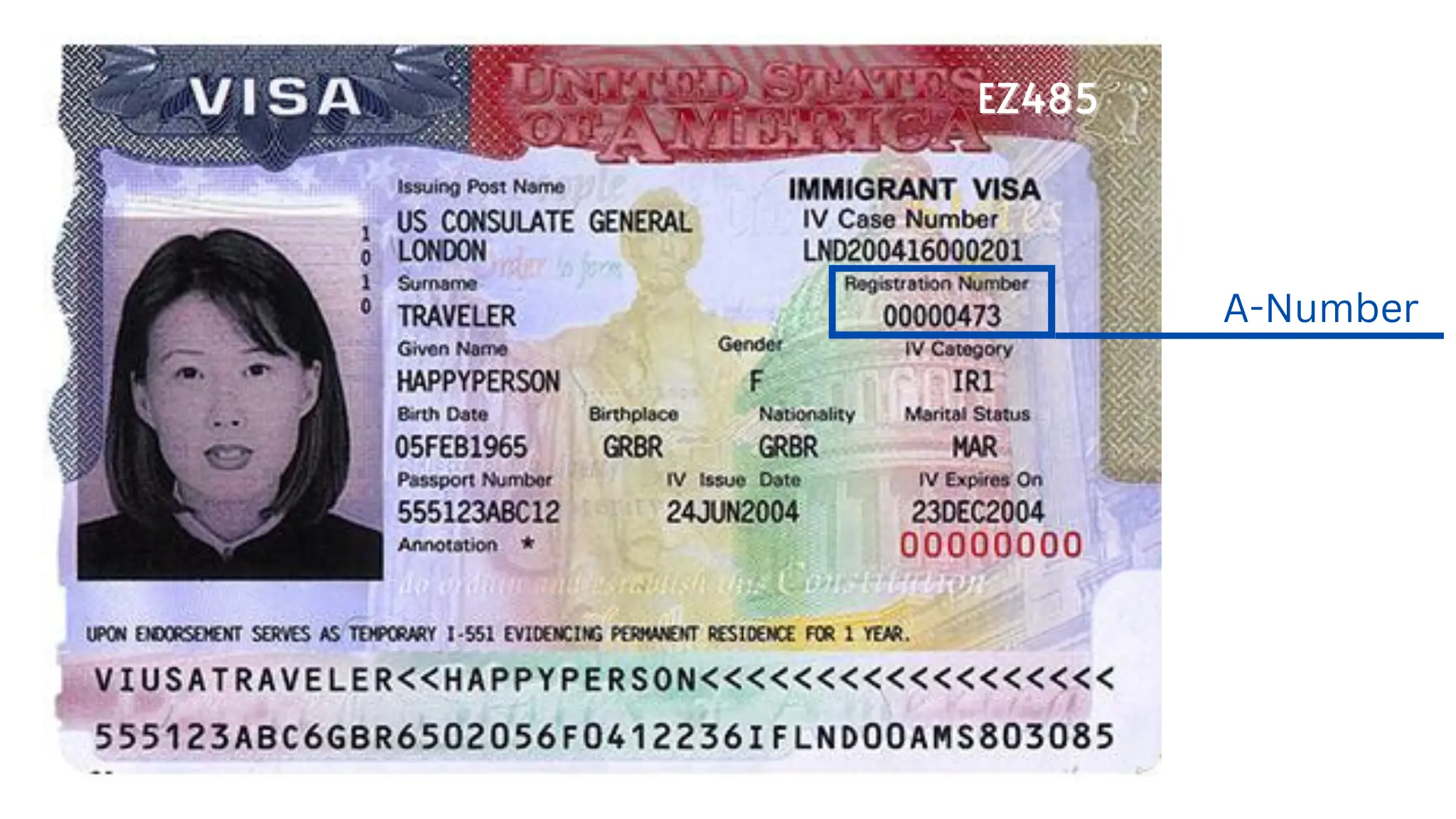
- Immigrant visa stamp. For those who applied through consular processing, the A-number — sometimes labeled as the “Registration Number” — appears in the upper right portion of the immigrant visa stamp in your passport. Note that nonimmigrant visas do not carry an A-number.
- Form I-797, Notice of Action. USCIS includes your A-number on notices related to your immigration case, including receipt notices and approval notices.
- Immigrant Data Summary. If you obtained your Green Card through consular processing, you may have received an Immigrant Data Summary as part of your visa package. Your A-number appears at the top of this document.
Who receives an A-number?
An A-number is assigned to noncitizens who are in the process of applying for or receiving immigration benefits. This includes individuals applying for a Green Card, asylum, or certain other statuses that may lead to or involve extended authorization to be in the United States.
Holders of temporary nonimmigrant visas — such as H-1B or F-1 visas — do not typically receive an A-number during the initial visa process, as these statuses are temporary and do not automatically lead to permanent residency.
However, an A-number may be assigned if a holder of one of these visas later pursues a Green Card or other qualifying immigration benefit. For example, F-1 holders may receive an A-number during Optional Practical Training if they apply for an Employment Authorization Document.

When you receive your A-number?
The timing of when an A-number is assigned depends on which immigration pathway you are pursuing.
For applicants filing for a Green Card from within the United States, the A-number typically appears on the Form I-797 receipt notice issued after Form I-485 is filed.
For those going through consular processing from abroad, the A-number is generally provided during the consular interview at the U.S. embassy or consulate, and also appears on the immigrant visa stamp placed in the passport.
How the A-number is used?
Your A-number serves several practical purposes throughout the immigration process and beyond:
- Immigration applications. Any time you file a form with USCIS, you will be asked to provide your A-number if one has been assigned to you. It links the new application to your existing immigration history.
- Case status tracking. Your A-number allows you to look up case information through the USCIS website or by contacting USCIS directly.
- Other government agencies and services. Your A-number may be required when applying for a driver’s license, a Social Security Number, or other government-issued documents and services.
It is worth noting that the A-number is distinct from both a Social Security Number and a USCIS case number. A Social Security Number is issued for employment and tax purposes and is administered by the Social Security Administration.
A USCIS case number is specific to a particular application or petition. The A-number, by contrast, is a lifetime identifier tied to you as an individual — it does not expire and follows you regardless of changes in your immigration status.
What to do if you cannot locate your A-number?
If you are unable to find your A-number, start by checking any immigration documents you have on hand, including prior USCIS notices, your Green Card, or your EAD. If the number still cannot be located, USCIS can assist in identifying or, if necessary, reissuing it.
You may need to provide personal information and details about your immigration history to facilitate that process. An immigration attorney can also assist with drafting a request to USCIS if needed.
Keeping a secure record of your A-number — along with copies of your key immigration documents — is a straightforward precaution that can simplify any future interaction with USCIS or other government agencies.
