

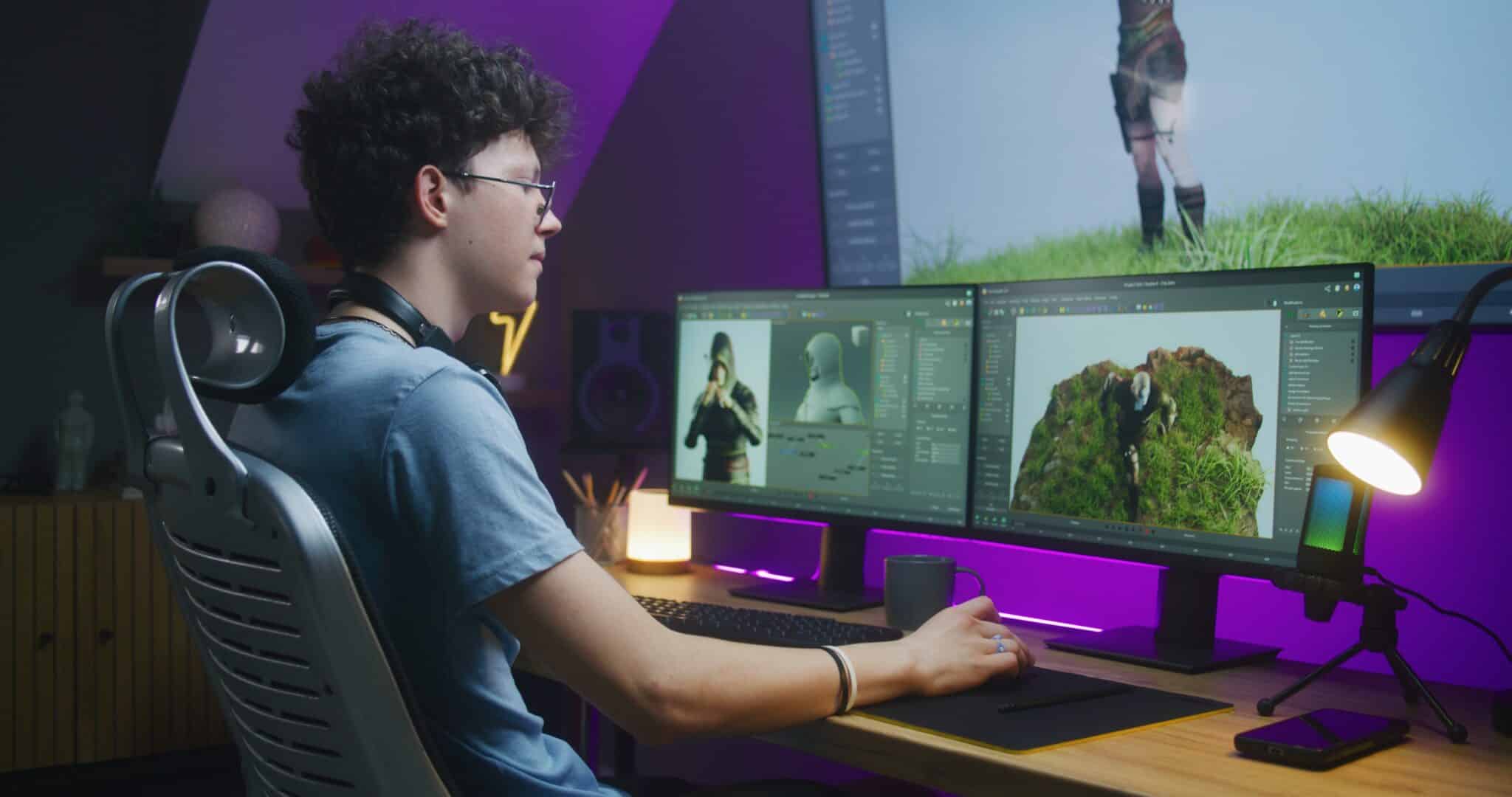
There has never been a time when game worlds got smaller or slower. No. They’re only getting bigger, denser, and more detailed. So now development teams are under pressure to constantly fill those game worlds with high-quality assets.
Textures, terrain, materials, and environmental effects need to be authored, refined, and integrated. And it’s all got to be done fast and at scale. Let’s face it: traditional workflows can’t keep up. The market had to innovate. So it did.
A new generation of creation tools is reshaping asset production, and developers stand to win big. Timelines are speeding up, and smaller teams are becoming more powerful. Now, fewer people can create entire worlds on tighter deadlines, and they can do it fast.
Out with the Old Workflow
In the beginning, creating just one visual effect for a game required multiple applications. You’d have to model a mesh in one tool and generate textures in another. You’d have to use an entirely separate app to author masks and noise maps.
Once that was done, you’d export, import, and reassemble everything in your game engine. Meanwhile, you’d be crossing your fingers that nothing broke along the way. Now multiply all that time for one effect across an entire open-world environment.
Yes, the old workflow was one of the most time-intensive parts of game development, and then you added the potential for friction, and it got worse. Every time one designer hands off an assignment to another, who’s working in a separate tool, there’s room for human error.
There’s potential for inconsistency. You may have to start over again, rework it, and cross your fingers again. And if design decisions change mid-production? Large portions of the process may go back to the drawing board.
Consolidate with Purpose
One of today’s biggest shifts is happening as a direct response to that old workflow: do more in one place. No more chains of specialized applications. Modern asset generation software allows for the consolidation of that workflow into a single, unified, node-based workflow.
This includes mesh creation, texture authoring, flipbook encoding, and procedural generation. So artists can author and preview how all assets interact with each other before anything leaves the tool.
One example of this asset generation software is IlluGen from JangaFX. Built specifically for real-time VFX and technical artists, you’ll get a single-node graph from which you can manage the full range of assets for a game effect:
- Tiling noise
- Flowmaps
- UV distortions
- Pivot-baked meshes
- Gradient masks
- RGBA-backed flipbooks
Think of Houdini or Substance 3D Designer, but with a specific focus on in-game visual effects.
Recently, a team of artists was working on generating VFX assets for a Fire Anomaly demo. They used IlluGen for asset generation and brought those assets into Unreal Engine 5’s Niagara system.
This approach saved them a ton of time they would have otherwise lost. No piecing together assets from multiple tools before getting any engine work done.
In the end, they noted a fluid handoff and a tighter feedback loop between asset generation and engine integration.
It’s Not Just VFX
Of course, this consolidation shift isn’t just about VFX assets. Terrain and environment generation tools are experiencing similar evolutions.
Teams once had to deal with manual sculpting and static asset placement. Now, artists can use a tool like JangaFX’s GeoGen to define the rules and parameters that generate terrain, vegetation distribution, and material variation. And they can do it at scale.
What these changes mean is that game maps can now grow in ambition unimpeded. Open-world video games have huge, sprawling maps, impractical for hand-crafting, inch by inch, no matter how talented the artist.
Procedural terrain gives artists the ability to maintain consistency and creative control at the same time because they can offload repetitive variation work to the system. And when they want to make changes, they don’t have to start from scratch.
When you can integrate these systems directly with simulation tools, like weather influencing the landscape, players get environments that feel like immersive experiences. It’s hard to get that level of quality, but it’s what players are asking for more and more.
But What About the Little Guys?
One benefit of modern asset tools that deserves more attention is that they give more power to smaller studios. It wasn’t too long ago when a two-person team simply couldn’t take on a large project.
They didn’t have the resources to build a dedicated pipeline for every asset type. But now, that same team can handle mesh generation, texture creation, and flipbook output in a single session with a single tool.
Efficiency absolutely aids creativity. When artists can spend less time managing tool handoffs, they can spend more time iterating on design. More iteration means more experimentation. More experimentation means better work.
This obviously doesn’t mean that larger studios don’t also benefit. They simply benefit at different points in the pipeline.
For AAA teams, the value often shows up in late-stage iteration, when a mechanic changes and associated effects need to be revised quickly, for example.
For large teams working on multiple projects, tools that allow rapid asset authoring without having to rebuild an entire pipeline from scratch are increasingly essential.
The Future: Meeting Artists Where They Work
Of course, this shift isn’t just a technical or even technological one. Rather, it’s the industry recognizing that modern game development is complex.
It’s an acknowledgment that the tools need to center the artists. It’s about meeting artists where and how they work, with node-based, consolidated workflows.
Studios that build their pipelines around these tools today are perfectly poised for what’s coming. As game worlds continue to grow in scale and player expectations continue to rise, the teams that can iterate the fastest and with the least overhead will have the most meaningful advantage.
The tools are here. It’s just a question of how quickly studios can adapt to them.
