

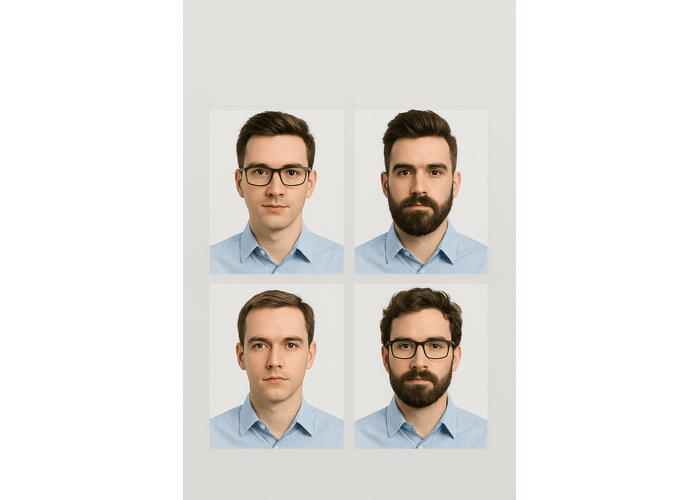
The DV Lottery photo seems simple, but many entries fail because the image does not follow U.S. visa photo rules. Glasses, facial hair, and hair styling are common trouble spots.
This guide explains exactly how these things affect your DV Lottery photo and what is safe (or risky) to do.
Quick recap: DV Lottery photo basics
DV Lottery photos follow the same standard as U.S. visa photos. In short, your photo must be:
- In color, with a plain white or off-white background
- Taken within the last 6 months
- Showing your full face, directly facing the camera
- With a neutral expression and both eyes open
- Properly framed (head centered, taking up the correct proportion of the image)
- Clear, bright, and in focus, with no heavy shadows
If the technical requirements (size, background, quality) are wrong, the system can reject your entry before anyone even looks at it. Within those rules, appearance details like glasses, beards, and hair must still keep your face fully visible and recognizable.
Glasses: almost always not allowed
Are glasses allowed?
For new U.S. visa and DV Lottery photos, glasses are generally not allowed. That includes:
- Prescription glasses
- Reading glasses
- Sunglasses
- Tinted or photochromic lenses
Only very rare medical situations are treated as exceptions, and even then you would need:
- A written statement from a doctor explaining why the glasses cannot be removed
- A photo with no glare, reflections, or frames covering any part of the eyes
In practice, if you are applying for the DV Lottery, the safe rule is: take the photo with no glasses at all.
Why this rule exists?
Modern systems rely heavily on facial recognition. Glasses can:
- Cover or distort the area around your eyes
- Create glare or reflections
- Make it harder to compare the photo with your face at the interview
To avoid these problems, the default is “no glasses.”
Practical tips
- Take off your glasses a few minutes before the photo to reduce red marks on the nose.
- Check the photo carefully for any leftover shadows where the frames usually rest.
- Do not compensate with heavy makeup or unusual styling; keep your face as natural and clear as possible.
Beards and facial hair: allowed, but keep your face clear
Are beards allowed in a DV Lottery photo?
Yes. You are allowed to have a:
- Beard
- Mustache
- Goatee
- Other facial hair styles
There is no requirement to be clean-shaven.
As long as your face is clearly visible and you look like yourself, facial hair is not a problem. Beards are treated as a normal variation in appearance.
What you should watch out for
- Your beard should not cast strong shadows that hide your mouth or jawline.
- Extremely unusual or “costume-like” styles that drastically change your apparent face shape can cause doubt.
- The key features of your face (eyes, nose, mouth, jawline) must still be easy to see.
What if you grow or shave a beard after submitting your photo?
Minor changes such as:
- Growing a beard
- Shaving your beard
- Trimming or reshaping facial hair
are normally treated as small appearance changes. As long as you are clearly the same person, this is acceptable.
For DV winners, that means:
- If your DV photo was clean-shaven but you have a beard at the interview, that is usually fine.
- If you had a beard in the DV photo and shave it later, that is also acceptable.
Only when facial hair is combined with other big changes (for example, major facial surgery plus heavy tattoos plus large weight changes) do you start to approach the “new photo needed” area.
Hairstyles: flexible, but your face must stay visible
Are there strict rules about hair?
There is no rule that:
- Your ears must show, or
- You must wear your hair in a specific style
However, your hair must not hide your face. That means:
- Hair cannot cover your eyes or eyebrows
- The outline of your face (forehead, cheeks, jaw) should be visible
- Big or high hairstyles must still fit in the frame without cutting off the top of the head
- Hair should not create heavy shadows over your face
Long hair, curly hair, braids, and afros are all fine, but keep them away from your eyes and face.
Head coverings and hair
Head coverings fall into two groups:
Allowed: daily religious headwear (e.g., hijab, turban, yarmulke) or certain medical coverings, as long as:
- Your full face is visible from hairline to chin
- There are no strong shadows on your face
Not allowed: fashion hats, caps, bandanas, or decorative scarves that are not part of daily religious wear.
Changing your hairstyle after the DV photo
Common changes such as:
- Cutting long hair short
- Growing your hair out
- Changing hair color
- Switching from straight to curly styling
are all considered minor. You do not have to keep exactly the same hairstyle from the DV photo until the interview. The important test is whether an officer can still recognize you easily.
When does a change become “too much”?
Typical examples of a major change of appearance include:
- Serious facial surgery or injury that alters your features
- Large additions or removals of facial tattoos or piercings
- Extreme weight loss or gain that changes your face shape
- Any combination of changes that makes you look like a different person at first glance
If friends or family say, “You look like a completely different person now,” that is a sign you might need a new photo for future applications, and as a DV selectee you should bring fresh compliant photos to your interview.
Simple checklist before you take your DV photo
Use this quick checklist for glasses, beards, and hair.
Glasses
- All glasses removed (including prescription and reading glasses)
- No sunglasses or tinted lenses
- No medical need to keep glasses on (if there is, you have a signed doctor’s note)
- No glare or reflection over the eyes
Beards and facial hair
- Facial hair is part of your normal look, or you are comfortable keeping it for a while
- Your mouth, nose, and jawline remain clearly visible
- The beard does not create deep shadows that hide your features
- You understand you can grow or shave later as long as you remain recognizable
Hair and head coverings
- Hair is not covering your eyes or eyebrows
- The edges of your face are visible
- No fashion hats, caps, or decorative scarves
- Any religious headwear shows your full face and does not cast shadows
If you can tick every box above, and your photo also meets the normal DV technical rules (size, background, quality, and 6-month recency), then glasses, beards, and hairstyles will not stop your DV Lottery photo from being accepted.
