

Every July, downtown San Diego transforms into the most concentrated gathering of pop culture enthusiasts, entertainment industry executives, brand marketers, and media professionals on the planet.
Comic-Con International draws well over 130,000 attendees to the San Diego Convention Center and surrounding Gaslamp Quarter, creating a marketing environment unlike anything else in the American events calendar.
For brands looking to cut through the noise and reach a highly engaged audience at street level, pedicab San Diego advertising has emerged as one of the most effective and cost-efficient outdoor media formats available — not just during Comic-Con, but across the full calendar of conventions, festivals, and events that make San Diego one of the busiest event cities on the West Coast.
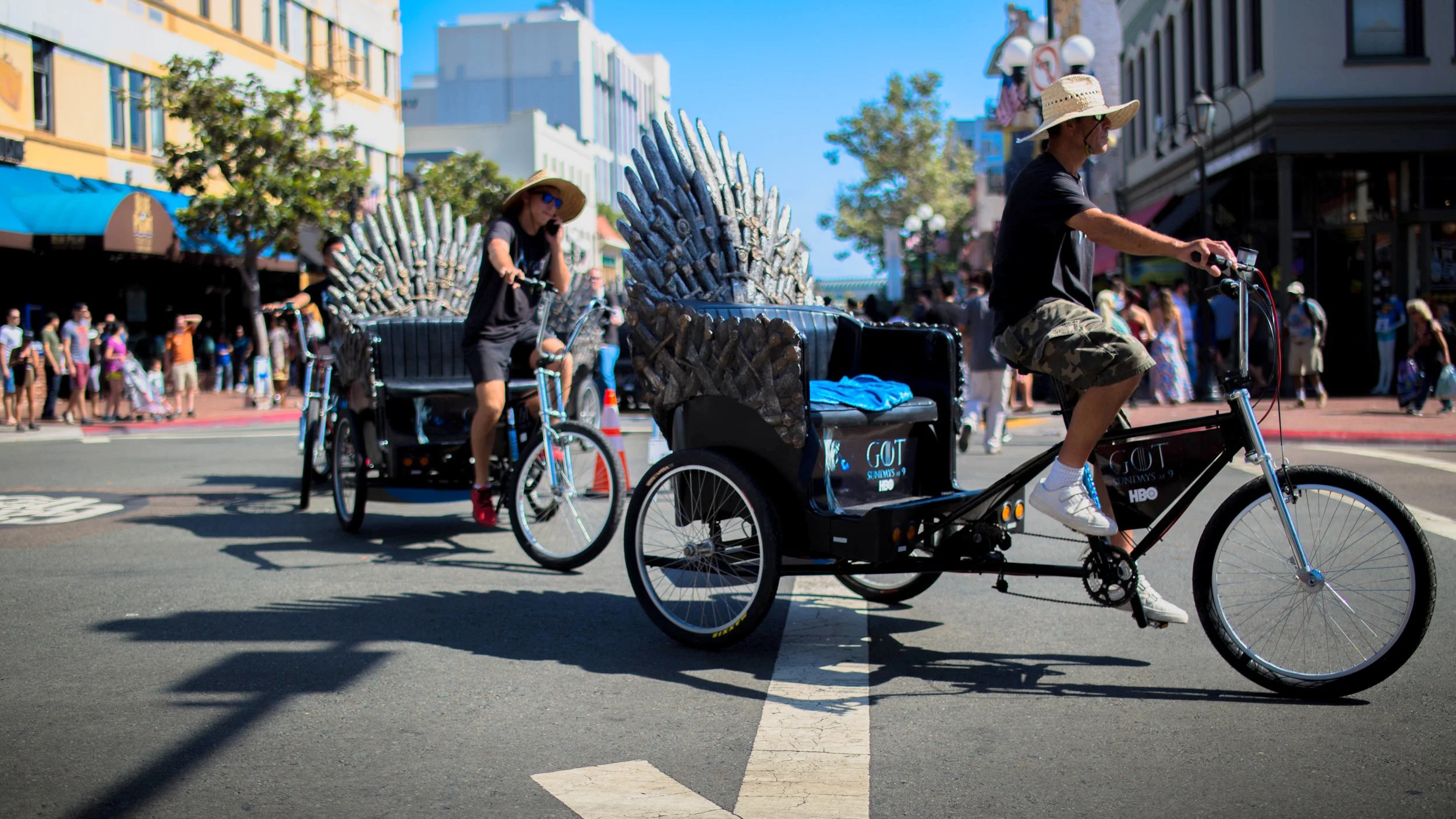
Why Pedicab Advertising Works Where Traditional Outdoor Media Fails?
Billboards stand still. Bus shelters blend into the urban landscape. Digital screens compete with dozens of other screens for a distracted viewer’s attention.
Pedicab advertising operates on an entirely different logic — it moves through the crowd, goes where cars cannot, parks in front of entrances, and puts your brand at eye level with the exact audience you are trying to reach.
Understanding why this format outperforms traditional outdoor media requires looking at the specific mechanics of how pedicab advertising delivers impressions in a dense urban event environment.
The Street-Level Advantage No Other Format Can Replicate
Most outdoor advertising formats are designed to be seen from a distance — from a moving vehicle, from across a street, from an elevated vantage point. Pedicabs operate at walking pace through the highest foot-traffic corridors in downtown San Diego.
Your wrapped pedicab moves through the crowd at the same speed as the people you are trying to reach, which means dwell time — the duration of a single impression — is dramatically longer than any static or moving billboard format.
A person walking along Harbor Drive toward the Convention Center entrance may be exposed to your pedicab advertisement for thirty seconds to several minutes depending on walking speed and street congestion.
No billboard, transit poster, or digital screen delivers that duration of uninterrupted brand exposure at eye level in a moving environment.
Why Comic-Con Creates the Perfect Pedicab Advertising Environment?
Comic-Con’s geography is what makes it uniquely suited to pedicab advertising. The event is concentrated in a compact area — the Convention Center, the adjacent Gaslamp Quarter, the Hilton Bayfront, the Marriott Marquis, and the surrounding hotel and restaurant district — that is largely inaccessible to traditional vehicle-based advertising formats during the event.
Street closures, pedestrian overflow, and traffic management during Comic-Con effectively eliminate standard billboard trucks and mobile advertising vehicles from the most valuable zones. Pedicabs, by contrast, are purpose-built for exactly these conditions.
They navigate pedestrian-heavy streets, stop in front of venue entrances, queue at hotel pickup points, and remain continuously visible in the highest-density areas throughout the event day.
Impressions Per Dollar: How Pedicab Advertising Compares
Outdoor advertising is measured in cost per thousand impressions — the cost of reaching one thousand people with your message.
Pedicab advertising in a dense event environment like Comic-Con generates impressions at a rate that rivals or exceeds far more expensive media formats, for a straightforward reason: your advertisement is physically present among the audience rather than positioned at the periphery of their attention.
Industry operators in San Diego report that a single wrapped pedicab operating during Comic-Con can generate between five thousand and fifteen thousand brand impressions per day, depending on route, event density, and operating hours.
Across a multi-day campaign with multiple pedicabs, total impression volume becomes substantial — at a fraction of the cost of equivalent exposure through digital or traditional outdoor formats.
Brand Ambassadors Built Into the Format
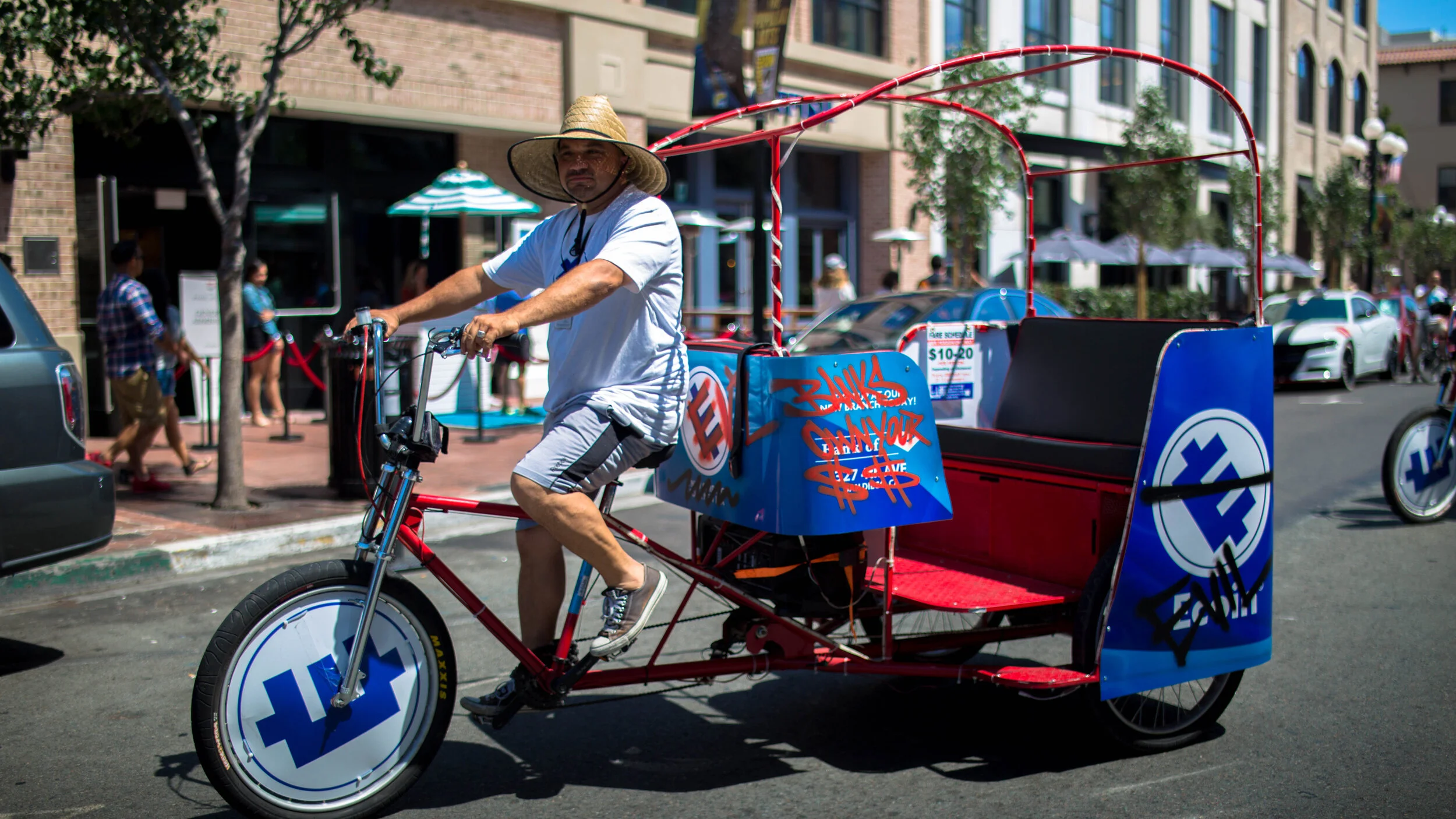
One dimension of pedicab advertising that consistently surprises first-time clients is the human element. Every pedicab comes with a driver — an actual person who interacts with passengers, exchanges words with pedestrians, and operates as an informal brand ambassador throughout their shift.
Pedicab operators in downtown San Diego during major events become points of contact between your brand and the audience.
They can distribute promotional materials, answer basic questions about your product or activation, direct convention attendees to your booth, and create the kind of spontaneous human interaction that no static advertisement can generate.
This combination of visual advertising and live human engagement is unique to the pedicab format and contributes significantly to its effectiveness in event environments.
Targeting Precision in a Dense Event Environment
One of the persistent challenges of outdoor advertising is targeting — the inability to direct your message specifically at the audience you want to reach rather than the general public. Event-based pedicab advertising in San Diego solves this problem elegantly.
When your pedicabs operate during Comic-Con, you are not advertising to the general San Diego population. You are advertising exclusively to the 130,000-plus attendees who have self-selected into the world’s most concentrated gathering of your target demographic.
When your pedicabs operate during a medical conference at the Convention Center, your audience is defined by professional specialty.
When they operate during the San Diego County Fair or a major sporting event at Petco Park, the demographic profile of your audience shifts accordingly. The event calendar is your targeting mechanism.
How to Run a Pedicab Advertising Campaign in San Diego?
Understanding why pedicab advertising works is the foundation. Building a campaign that actually delivers on that potential requires attention to the operational details that separate effective campaigns from wasted budget.
This section walks through the complete process of planning and executing a pedicab advertising campaign in San Diego.
Step-by-Step Campaign Planning Process
- Identify your target event and confirm the dates, venue locations, and expected attendance figures well in advance — popular events like Comic-Con require booking months ahead.
- Define your campaign objective — booth traffic, brand awareness, product sampling, or a combination — since the objective shapes every subsequent decision.
- Determine the number of pedicabs you need based on event size, geographic coverage area, and daily impression targets.
- Brief your pedicab advertising provider on your brand guidelines, key messages, and any restrictions on driver behavior or route areas.
- Submit your artwork for pedicab wrap production, ensuring files meet the provider’s size and resolution specifications.
- Confirm whether your campaign will include promotional material distribution, driver uniforms, or sponsored free rides for attendees.
- Establish a daily reporting structure with your provider so you receive impression data, route coverage, and photographic documentation throughout the campaign.
- Plan a post-campaign review to evaluate cost per impression, qualitative feedback, and booth traffic lift attributable to pedicab exposure.
Choosing the Right Pedicab Advertising Partner in San Diego
San Diego has several established pedicab advertising operators, and the differences between them matter significantly when you are planning a high-stakes campaign around a major event.
The right partner has a proven track record at the specific events you are targeting, a professionally maintained fleet with high-quality wrap installation, experienced drivers who understand brand ambassador expectations, and in-house or closely coordinated print production so wrap quality meets professional standards.
Ask any prospective partner for case studies from previous Comic-Con or Convention Center campaigns. Ask to see examples of wrapped pedicabs in the field.
Confirm their licensing and permitting status for downtown San Diego operating zones, since unlicensed operators create legal and reputational risk for the brands they carry.
Extending Your Campaign Beyond Comic-Con
Comic-Con may be the marquee event for pedicab advertising in San Diego, but it represents just one opportunity in a calendar full of high-value events.
The San Diego Convention Center hosts more than 200 events annually, including major medical, technology, and industry conferences that attract professional audiences with significant purchasing power.
Beyond the Convention Center, pedicab advertising performs strongly during Padres home games at Petco Park, the San Diego County Fair at Del Mar, the Gaslamp Quarter’s restaurant and nightlife peak periods, and large-scale outdoor festivals across Mission Bay and Balboa Park.
A brand that establishes a presence across multiple events throughout the year builds cumulative recognition with San Diego’s local and visiting audience at a cost structure that no other outdoor format can match.
Artwork and Wrap Design Best Practices for Pedicab Advertising
The visual design of your pedicab wrap is the single most controllable variable in your campaign’s effectiveness. A well-designed wrap turns every pedicab into a high-impact moving advertisement. A poorly designed wrap wastes the exposure your campaign generates.
Effective pedicab wrap design prioritizes legibility above all else. Your brand name, logo, and primary message must be readable in under three seconds by someone standing five to ten feet away in a crowded street environment.
High-contrast color combinations, bold typography, and a single clear call to action consistently outperform complex, information-dense designs that require sustained attention to decode.
Work with your pedicab provider’s design team or brief your own designer with the exact pedicab dimensions and wrap template before creating artwork.
Colors should be specified in CMYK for print accuracy, and all text should be outlined to prevent font substitution on output.
Measuring the ROI of Your San Diego Pedicab Campaign
Return on investment for pedicab advertising is measurable through several complementary methods. Impression volume can be estimated from route data, operating hours, and event attendance figures provided by the operator.
Booth traffic lift can be measured by comparing daily visitor counts during pedicab-active hours against baseline periods.
Promotional material distribution — flyers, coupons, product samples — provides a direct count of audience touchpoints generated by your driver team.
For brands running integrated campaigns that combine pedicab advertising with digital or social media activity, pedicab-specific QR codes or landing page URLs provide trackable conversion data that links street-level exposure directly to online engagement.
Making Pedicab Advertising a Core Part of Your San Diego Marketing Strategy
The brands that get the most from pedicab advertising in San Diego are not the ones that treat it as a one-time experiment during a single event.
They are the ones that recognize it as a repeatable, scalable, and uniquely effective format for reaching engaged audiences in environments where conventional outdoor media cannot compete.
Comic-Con is the obvious starting point — the scale, the audience quality, and the geographic concentration make it the highest-value single event in the San Diego advertising calendar. But the same logic that makes pedicab advertising effective at Comic-Con applies across dozens of events throughout the year.
Build your presence at one event, measure the results carefully, and use that data to make the case for expanding your pedicab footprint across the full San Diego event calendar. The audience is already there. The question is whether your brand is moving through it.
