

Your personal information is already out there. Not in a scary, hopeless way, just as a plain fact of modern life: every account you open, every form you fill in, and every company you trust with your details adds another copy of your data to the internet.
The question is not whether your information exists online. It is whether you would notice if someone started misusing it.
That is what monitoring is really about. Most people discover identity theft the slow, painful way, when a strange charge appears or a loan they never took out shows up on their credit report.
Monitoring flips that timeline. It is the difference between catching a problem in days rather than months, and it is far more doable than it sounds.
Why monitoring matters more than ever?
The scale of the problem is easy to underestimate. In 2024 alone, the U.S. Federal Trade Commission received more than 1.1 million reports of identity theft, and consumers reported losing over $12.5 billion to fraud, a 25 percent jump from the year before. Those are only the cases people noticed and bothered to report.
The raw material for that fraud comes from data breaches, and they are enormous. Late in 2025, the Cybernews research team discovered a single unprotected database exposing roughly a billion records of personal data across 26 countries, including names, addresses, dates of birth, and national ID numbers.
When information like that leaks, it gets bundled, sold, and reused for years. The same team behind the widely reported “Mother of All Breaches” investigation has repeatedly shown how leaked details from unrelated sources get stitched together into complete profiles of real people.
You cannot un-leak your data. What you can do is watch for the moment it gets used against you.
What “monitoring” actually means?
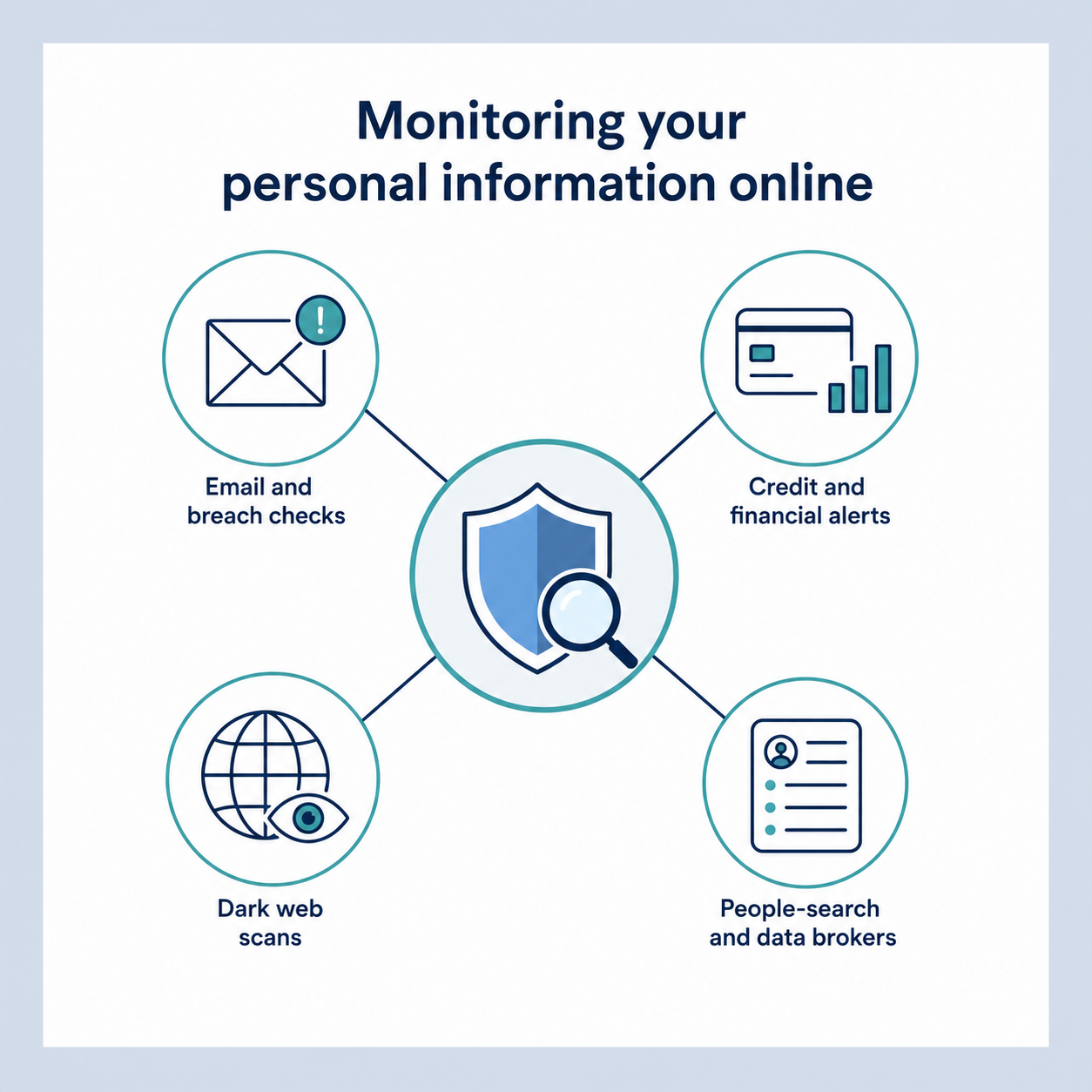
Monitoring is not one tool or one action. It is a habit of keeping an eye on the specific places your information tends to surface. Broadly, there are four fronts worth watching:
- Your logins and passwords, to catch when an account you use turns up in a known breach.
- Your financial life, including bank alerts and your credit report, where new fraudulent accounts show up first.
- The dark web and breach marketplaces, where stolen personal data gets traded.
- Data broker and people-search sites, which quietly compile and sell your address, phone number, and family details.
You do not need to tackle all four at once. Even covering the first two puts you ahead of most people.
A simple monitoring routine
Here is a realistic way to divide the work, based on how often each task actually needs your attention. The point is not to live in fear of your data, but to build a light routine you will actually keep.
| What to monitor | How to check | How often |
| Email and password breaches | Free breach-check sites and browser or password-manager alerts | Set up alerts once, review as they arrive |
| Bank and card activity | Enable transaction alerts in your banking app | Automatic, glance weekly |
| Credit report | Free annual reports from major bureaus, or a monitoring service | Every few months |
| Dark web exposure | An identity monitoring service that scans breach data | Continuous, via the tool |
| Data broker listings | Search your name, then request removal | A few times a year |
The habits in the top rows are free and take minutes. The lower rows are where paid tools start to earn their place, because scanning the dark web or chasing down dozens of data brokers by hand is not realistic for most people.
When a monitoring service is worth it?
At some point, doing everything manually stops being practical, and that is where identity monitoring tools come in. A good service watches your data continuously and tells you what to do the moment something appears.
If you want a clear, tested overview of the options and how to prevent identity theft before it snowballs, the Cybernews team reviews these services hands-on, setting up real accounts and timing how fast each one flags exposed credentials rather than relying on marketing claims.
According to testing by Cybernews experts, the better tools surface old breaches within hours of setup and combine several protections at once: dark web scanning, credit and financial alerts, data broker removal, and recovery help if the worst happens.
Their reviews also stress a point worth repeating, which is that the value is not in the alert itself but in how clearly a service tells you what to do next. An alert with no guidance just creates anxiety. A good one turns a scary moment into a short checklist.
Turning monitoring into action
Catching something is only useful if you know the next step. If an alert shows a breached password, change it everywhere you reused it and switch on two-factor authentication.
If you spot an unfamiliar account or credit inquiry, contact the bank and consider freezing your credit, which is free and stops most new-account fraud cold. If your data shows up on people-search sites, submit removal requests one by one, or let a tool handle it.
None of this requires becoming a security expert. It requires a small shift in mindset: from hoping nothing goes wrong to noticing quickly when it does. Set up a couple of alerts this week, jot down the accounts you need to secure, and treat it as routine digital maintenance, like backing up your phone.
For a broader picture of how these reports feed national fraud tracking, the FTC’s Consumer Sentinel data is a useful, plain-language reference. And if you want to keep a running checklist as you work through your accounts, a simple note in your DigitalEdge account is an easy way to track what is done and what is left.
Your information may already be out there. Watching over it, calmly and consistently, is how you stay one step ahead of the people who would misuse it.
