

Every IT department has a memory stash. Maybe it is a drawer, maybe it is a shelf, maybe it is three antistatic bags shoved behind the spare power supplies.
Server RAM accumulates quietly, and because any single stick is small, it never quite feels worth dealing with. So it sits, and sits, and slowly becomes somebody else’s problem to sort out years later.
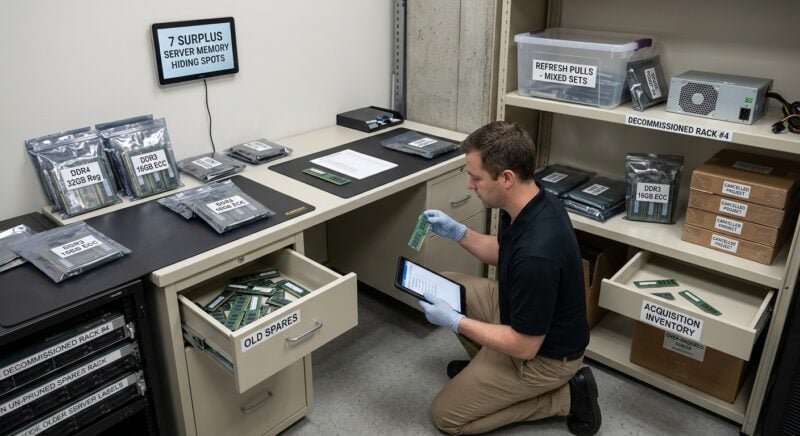
That is a shame, because server memory is one of the best-value things to come out of a server. It holds its worth better than almost any other component, it is simple to handle, and right now it is in unusually strong demand.
The first step to doing something about it is knowing where it piles up. Here are the seven usual suspects, and what to do once you have found them.
1. The hardware refresh
The big one. When a fleet of servers gets replaced, the memory often comes out with it, sometimes hundreds of modules at once. These pulls tend to go straight into storage because everyone is focused on standing up the new gear, and nobody wants to deal with the old pile mid-project.
The upside is that refresh pulls are usually matched sets of identical modules, which are the easiest kind to value and sell later, so they are worth keeping organized rather than tipping into one bin.
2. The capacity upgrade
You bump a set of servers from 32GB modules to 64GB ones to give the fleet room to grow. The new memory goes in, and the old, smaller DIMMs come out with nowhere to go.
They are perfectly good. They are just not what you need anymore, and smaller modules in good condition still have a healthy secondary market.
3. The decommission
A rack gets retired, a product line gets sunset, a workload moves to the cloud. Whatever was in those machines is now surplus, memory included.
Decommissions produce some of the largest and most forgettable memory stashes, because the attention is on shutting things down, not on what comes out. It is worth noting the module details as you pull them, while the configuration is still in front of you.
4. The over-order
Someone bought memory for a project that then got smaller, or ordered spares in bulk for a better price and never needed most of them.
Sealed, unused modules sitting in a box are about as close to cash as hardware gets, and they are the easiest to forget you have. Factory-sealed memory also tends to command the strongest resale pricing, so this is the surplus you least want gathering dust.
5. The cancelled project
The initiative that was going to need forty servers got shelved after you had already bought the memory for it. Now it sits, often still in its packaging, quietly losing value while it waits for a deployment that is never coming. The sooner you accept the project is not happening, the more that memory is worth.
6. The spares pool that outgrew its purpose
Keeping spares for the systems you run is smart. The problem is that spares pools rarely get pruned. Two refreshes later, you are still holding “spares” for a server generation you no longer operate. Those are not spares anymore. They are inventory you have not sold, aging a little more with every month on the shelf.
7. The acquisition
If your company absorbed another one, you may have inherited their stash too, scattered across their old sites and never folded into your records.
Post-merger cleanups routinely turn up memory nobody on your side knew existed, sometimes in real quantity, which makes it worth a deliberate sweep rather than a guess.
The quiet cost of letting it sit
None of these stashes are unusual, and individually none of them feel urgent. Together, though, most organizations are sitting on far more usable memory than they realize, and all of it is doing the same thing: slowly losing value.
Memory tied to an aging generation is worth the most today and a little less every month, so “we will deal with it eventually” is really a decision to recover less money than you could have.
So what do you actually do with it?
Once you know where it hides, the plan is simple. Work out how much spare memory you genuinely need for the systems you still run, keep that, and move the rest on while it still has value.
For the surplus, the straightforward route is to sell surplus server memory to a specialist buyer who can price it against current demand and handle it securely.
A little prep gets you a better result. Sort the modules by generation, capacity, and type, registered or unbuffered, ECC or not, because matched, counted lots are easier to value and sell than a mystery box. Keep them in antistatic packaging so they stay in good condition.
Note the part numbers and quantities, since a precise list earns a firmer quote than a vague one. And do not worry about data: memory is volatile and holds nothing once it loses power, which makes it far simpler to sell than drives. Complete systems are a different story and need proper data handling.
Why now, specifically?
There is a timing angle worth knowing. Memory prices have been running high, driven by AI systems soaking up supply, which means used server RAM is fetching strong prices on the secondary market.
The modules in that drawer are worth more today than they were a year ago, and holding them is costing you more than it used to. The stash is not going to get more valuable by sitting there, so flush it out while the market is on your side.
