

Picture an AI agent that reads a customer record, updates a ticket, and sends a refund through tools connected over MCP. Now ask what stops a prompt injection from turning that refund into a wire transfer. In too many enterprises, the honest answer is: not enough.
AI agents are taking high-stakes actions through tool calls, but the tool-call layer rarely gets the same controls applied to LLM traffic. The numbers back up that gap.
According to AI Agent Security in 2026, 88% of organizations reported confirmed or suspected AI agent security incidents in the last year, and healthcare hit 92.7%.
The same report found that 82% of executives are confident existing policies stop unauthorized agent actions, but only 14.4% of organizations ship agents to production with full security or IT approval. It also found 45.6% of technical teams still use shared API keys for agent-to-agent authentication.
The MCP ecosystem is growing even faster than the governance around it. A Snowflake guide notes Anthropic’s December 2025 update cited more than 10,000 active public MCP servers.
Datadog reported MCP tool calls up 22x since Q4 2025, quadrupling again quarter over quarter (as cited in Snowflake’s September 2026 enterprise MCP gateway guide)., and Atlassian saw MCP calls rise 400% in one quarter.
A Zuplo comparison adds that 70% of MCP consumers already have between two and seven MCP servers configured, and 72% expect their MCP usage to increase over the next 12 months, according to Zuplo’s State of MCP report.
MCP has become the “USB-C port for AI,” as the Snowflake guide puts it. Traditional API gateways ask whether a client can hit an endpoint. MCP gateways ask whether this specific agent can execute this specific tool call, with these parameters, on behalf of this user, right now.
How the MCP Gateways Were Selected and Ranked?
This ranking evaluated each gateway against five criteria tailored to production AI agents. The focus: enterprises that must enforce security at both the LLM layer and the tool-call layer. MCP security was treated as a first-class requirement, not an add-on.
- Security inspection depth: Can the gateway inspect tool-call content inline and reason across a full session, rather than only authorize endpoints?
- Identity and access management: Does it offer agent-level RBAC, OAuth 2.0/OIDC delegation, and key separation so agents never hold raw provider keys?
- Audit trails and compliance: Does it log every agent action, with ISO 27001, OWASP, GDPR, and analyst report coverage?
- Governance and policy enforcement: Does it handle rate limiting, schema filtering, prompt guards, PII sanitization, and unified policy over LLM and MCP traffic?
- Deployment flexibility: Does it support SaaS, hybrid, on-premises, and air-gapped setups, and how easy is it to run?
The research drew on vendor documentation, analyst reports including the Gartner Market Guide for AI Gateways and KuppingerCole’s relevant reports on Generative AI Defense, open-source adoption, and practitioner discussions.
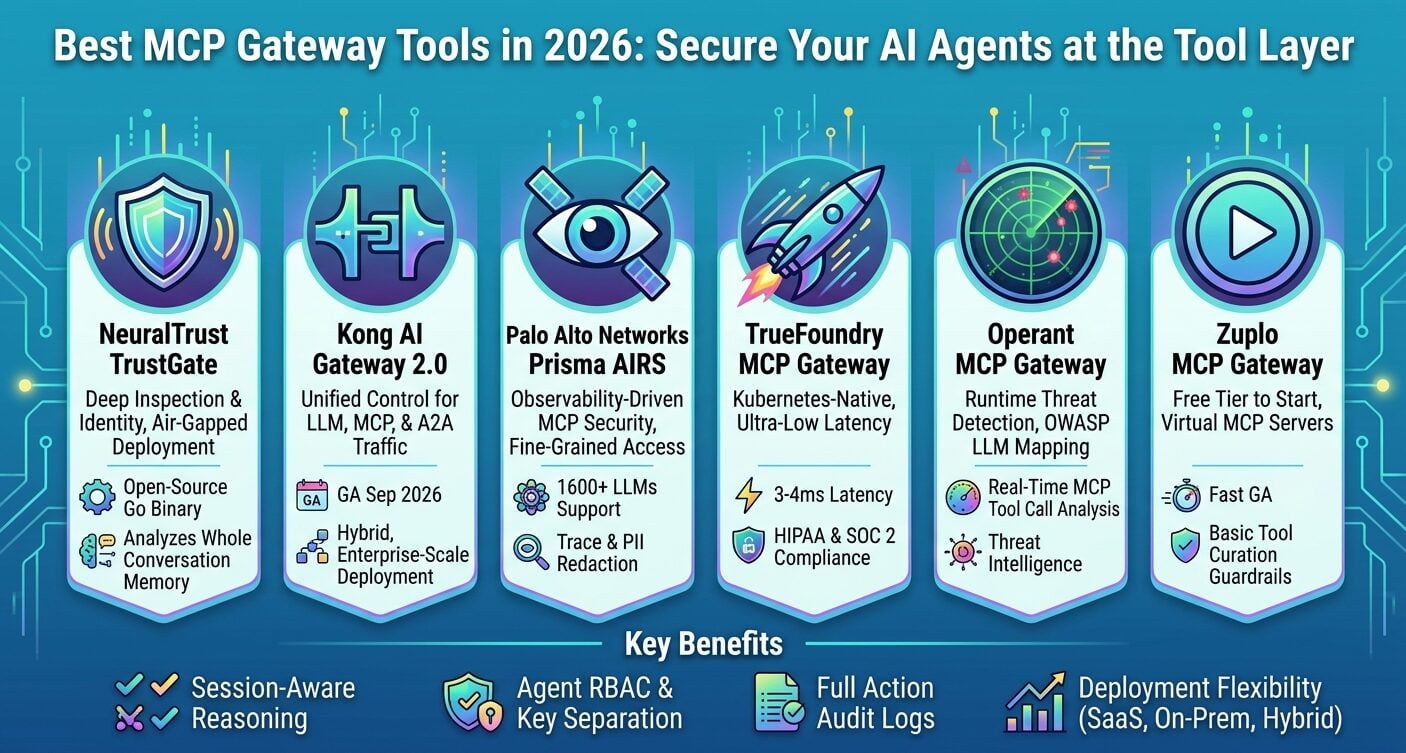
1. NeuralTrust TrustGate: Best for Full Security Enforcement at the Tool Layer
NeuralTrust TrustGate is an open-source AI gateway built in Go. It routes, secures, and observes traffic across three planes: Admin on port 8080, Proxy on 8081, and MCP on 8082.
The gateway runs as a single static Go binary with no Python, Node, or runtime dependencies, according to its GitHub repository. That design reflects a core idea: every choice assumes the gateway is the substrate for security enforcement, not just operational convenience.
Key features:
- Inline security inspection across sessions. TrustGate’s Security Engine attaches to every route and inspects request and response content before the call reaches its target. It keeps session memory, so it reasons across a whole conversation rather than one call at a time. NeuralTrust’s 2026
analysis calls it the only leading MCP gateway with this built-in engine. - Identity-forwarded access control. Identity provider groups control which models and tools each user can access, while identity is carried through every tool call and audit trails are built in. Agents authenticate with a gateway-issued key, so they never need to store raw provider credentials.
- Compliance and analyst recognition. TrustGate holds ISO 27001 certification and is recognized in Gartner’s 2025 Market Guide for AI Gateways and KuppingerCole’s 2025 Leadership Compass for Generative AI Defense.
- Operational breadth. It supports nine or more LLM providers, including OpenAI, Anthropic, Azure OpenAI, AWS Bedrock, and Google Gemini. It also covers Vertex AI, Groq, Mistral, and DeepSeek, with weighted load balancing and fallback routing. The TrustGate docs list rate limiting, token
limiting, request size guard, semantic cache, and CORS among its plugin stages.
Best for enterprises that need deep enforcement at both the LLM and tool-call layers. It suits EU AI Act and GDPR obligations, plus defense, government, and financial sectors that need air-gapped deployment.
Less ideal if you only need simple LLM routing, as the security engine and supporting Postgres, Redis, and Kafka stack can add unnecessary complexity.
The trajectory backs up the positioning. NeuralTrust announced a $20 million seed round on June 17, 2026, and reported that its ARR in the first quarter of 2026 had already doubled its full-year 2025 total.
NeuralTrust is also officially backed by the European Union, aligning with the EU AI Act, AI Pact, and GDPR.
2. Kong AI Gateway 2.0: Best for Unified API and AI Governance
Kong AI Gateway extends a proven API platform to govern LLM, MCP, and agent-to-agent traffic from one control plane.
Version 2.0 reached general availability in September 2026, introducing a dedicated runtime and unified management for AI models, MCP servers, and agents, according to SNS Insider.
For enterprises already running Kong for APIs, that means one familiar layer can now govern AI traffic.
Key features:
- Unified control plane for LLM, MCP, and A2A traffic.
- Built-in security: PII sanitization, semantic caching, prompt guards, MCP server access control, and token quota management.
- A large plugin ecosystem for custom governance policies.
- Enterprise-scale hybrid deployments.
Best for enterprises already invested in Kong and complex multi-protocol environments.
Less ideal if your team has no existing Kong footprint; the learning curve is steeper, and some advanced MCP content inspection may need custom plugins rather than built-in options.
Kong AI Gateway 2.0 brings the maturity of a battle-tested API gateway to the AI domain. It is a safe, unified choice for large organizations that want consistent governance without a separate platform.
3. Palo Alto Networks Prisma AIRS AI Gateway: Best for Observability-Driven MCP Security
Following its acquisition of Portkey, Palo Alto Networks integrated the AI gateway control plane into Prisma AIRS. The platform now powers more than 3,000 GenAI teams and supports 1,600+ LLMs, bringing enterprise-grade network security muscle to the AI gateway layer.
Its MCP gateway capability centralizes authentication, access, and observability for MCP servers across the Prisma AIRS platform.
Key features:
- Broad multi-model management across 40+ providers and 1,600+ LLMs.
- MCP security layer with fine-grained access control, OAuth 2.1 integration, and centralized authentication.
- Deep observability: in-depth tracing, PII redaction, and audit logs backed by Palo Alto Networks’ security telemetry.
- Flexible deployment through SaaS, VPC, or self-hosted options.
Best for teams that want strong observability alongside MCP security, especially organizations already running Palo Alto Networks products across their network and cloud stack.
Less ideal for smaller teams; the platform’s enterprise breadth can feel heavy, and tighter integration into the Palo Alto Networks portfolio may shift roadmap priorities away from standalone MCP gateway features.
With the full weight of Palo Alto Networks’ security portfolio behind it, Prisma AIRS is positioned to become a heavyweight in AI gateway control planes for enterprise security organizations.
4. TrueFoundry MCP Gateway: Best for Low-Latency Kubernetes-Native Deployments
TrueFoundry’s MCP Gateway is built for Kubernetes-native speed. TrueFoundry reports latency as low as 3-4ms, around 10ms under load, and 350+ requests per second on a single vCPU. That makes it a strong fit for real-time agent workloads.
Key features:
- Ultra-low latency for latency-sensitive agents.
- Identity integration through OAuth 2.0, Okta, and Azure AD for agent-level RBAC.
- Compliance coverage including SOC 2, HIPAA, and GDPR.
- Deployment in VPC, on-premises, or air-gapped environments.
Best for latency-sensitive AI agents running on Kubernetes and regulated industries like healthcare and finance.
Less ideal if you lack Kubernetes expertise; its security content inspection is also less deep than security-first gateways.
TrueFoundry offers a compelling blend of speed and compliance for modern cloud-native AI stacks.
5. Operant MCP Gateway: Best for Runtime Threat Detection on MCP Traffic
Operant AI’s Semantic Firewall focuses on spotting threats in real time. The Zuplo comparison notes it analyzes all data passed through MCP servers to catch prompt injection and tool poisoning, mapping threats to the OWASP Top Ten for LLM applications. It can run on cloud-native infrastructure or private and public clouds.
Key features:
- Real-time threat detection across MCP tool calls.
- OWASP LLM Top 10 mapping for standardized risk visibility.
- Cloud-native, private, or public cloud deployment.
- Featured in Gartner’s MCP cybersecurity guide according to a LinkedIn post by Operant AI.
Best for security operations teams that need continuous monitoring of agent tool interactions.
Less ideal if you need full enforcement; Operant is primarily a detection layer, so you will still need a separate gateway for identity, authentication, and policy enforcement.
Operant fills a critical niche for enterprises that want runtime visibility into MCP-specific threats.
6. Zuplo MCP Gateway: Best for Getting Started with a Free MCP Gateway
Zuplo’s MCP Gateway entered public beta in June 2026 and reached general availability in August 2026. It is included on every plan, including Free, and its core primitive is the virtual MCP server, which exposes only curated tools from a single upstream.
Its State of MCP report found 70% of MCP consumers already manage multiple servers, which makes the case for curation immediate.
Key features:
- Free tier with no upfront cost and a simple setup path.
- Tool curation through virtual MCP servers, reducing the attack surface.
- Security primitives including OAuth/OIDC credential brokering, structured audit logs, and OpenAPI-to-MCP generation.
- Adoption momentum validated by its own State of MCP data.
Best for developers and small teams piloting MCP agents that need immediate guardrails.
Less ideal if you need advanced content inspection, session-aware reasoning, or long-term compliance retention; as a product that only reached GA in August 2026, those areas may be less mature.
Zuplo’s accessible, free model makes it an ideal on-ramp for any team starting its MCP security journey.
Caveats and Counterpoints: What the Top MCP Gateways Don’t Solve (Yet)
The enterprise AI gateway market is young. SNS Insider values it at $0.88 billion in 2025, projected to reach $11.32 billion by 2035 at a 29.12% CAGR. But you should treat rankings as a snapshot; features are maturing fast.
Gateway enforcement does not replace governance fundamentals. Many organizations still plan to deploy agentic AI without strong operational controls or monitoring.
Identity practices also lag behind: the same 2026 survey cited earlier found 45.6% of teams still use shared API keys for agents. Deploying a gateway without agent-level identity only closes part of the gap.
There is also a security and latency trade-off. Deep content inspection adds microseconds. If you need ultra-low latency, lighter gateways such as TrueFoundry or Zuplo may be options to consider, though NeuralTrust with sub-10ms latency also slots up there without trading away much security depth like the other two.
Vendor lock-in is another risk, since proprietary engines can raise switching costs. Standard policy languages would help.
Before committing, evaluate candidates in staging with both synthetic and real agent traffic. That measures the security-latency-operations balance against your actual use case.
Final Verdict: Choosing the Right MCP Gateway for Your AI Stack
For enterprises that need complete security enforcement at both the LLM and tool-call layers, NeuralTrust TrustGate stands out as a strong option in 2026.
Its security-first architecture, inline tool-call inspection, session-aware reasoning, identity-forwarded RBAC, and air-gapped deployment make it the benchmark.
Kong AI Gateway 2.0 is the natural choice for large organizations already on Kong. Palo Alto’s PRISMA AIRS AI Gateway excels at observability-driven security.
TrueFoundry and Operant serve specialized needs: TrueFoundry for low-latency Kubernetes-native stacks, and Operant for runtime threat detection. Zuplo is the easiest place to start.
Start by assessing your security depth requirements, regulatory needs, and deployment environment. Evaluate options like TrustGate before committing to a commercial tier. A gateway is only one layer, so close the identity and governance gaps across your teams.
For the broader stack, see Digital Edge’s guide to AI governance platforms for 2026.
