

Taking an online intelligence test creates an unusual experience: after answering a series of questions, you receive a number that appears to summarize something extremely complicated about yourself.
That can make a MyIQ result feel more definitive than it actually is.
A high score may be reassuring. A lower-than-expected score may be uncomfortable. Either way, the natural temptation is to connect the result with much bigger questions about academic ability, career potential, productivity or even personal worth.
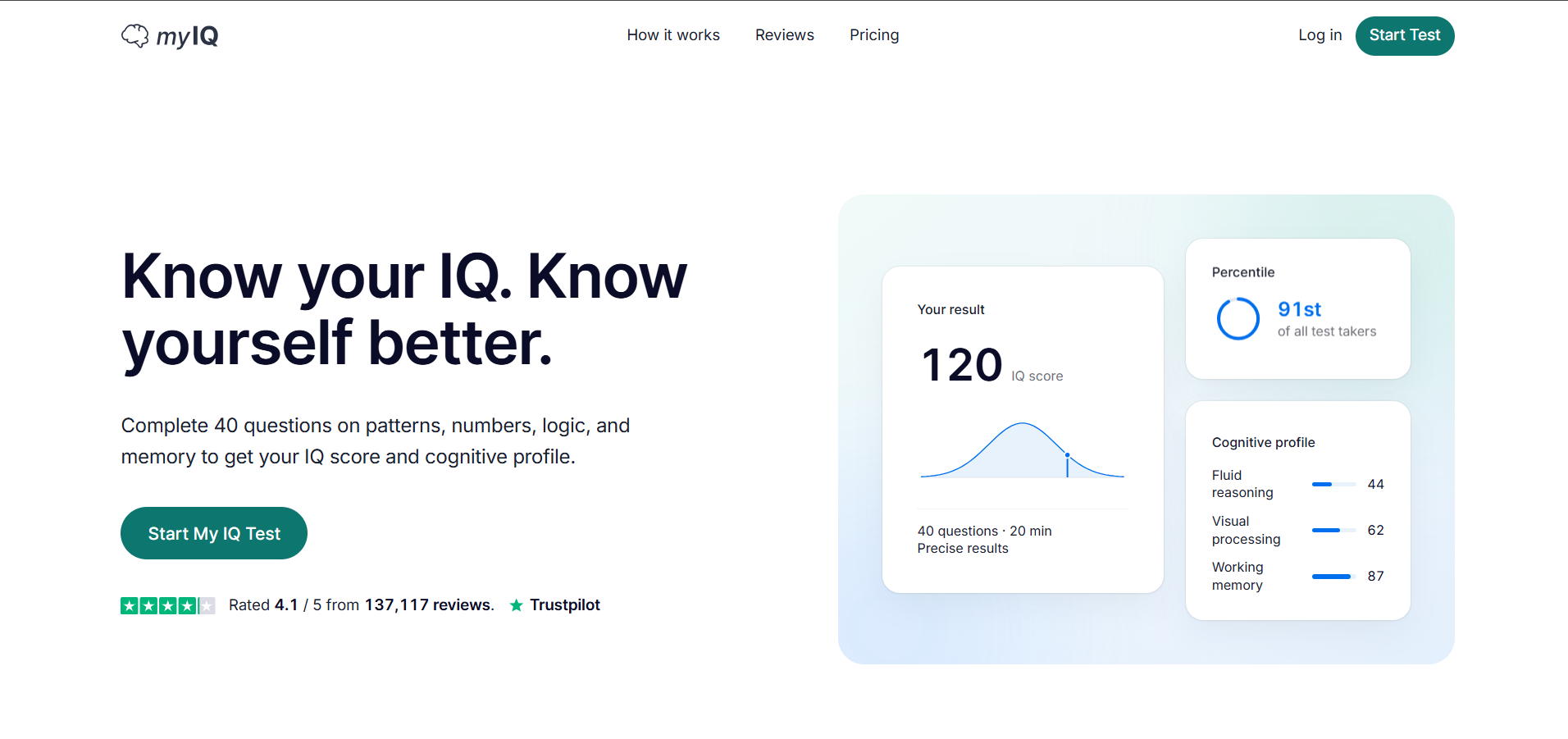
This is where interpretation becomes more important than the number itself.
An online IQ result can provide information about performance on the tasks included in the assessment. It cannot by itself explain everything a person is capable of doing outside that testing environment.
What Is MyIQ Measuring?
When somebody takes MyIQ, they are completing a particular set of cognitive tasks rather than undergoing a complete evaluation of every ability that might matter in everyday life.
IQ-style assessments commonly involve areas such as logical reasoning, recognising patterns and solving structured problems.
Those abilities are meaningful, but they are not interchangeable with every other skill.
Daily performance can also depend on factors such as:
- knowledge and experience;
- attention;
- persistence;
- communication;
- planning;
- creativity;
- learned skills;
- motivation;
- working habits;
- familiarity with a particular type of problem.
This is one reason two people who perform similarly on an intelligence test can still perform very differently at work, university or in their personal lives.
The score describes performance within the assessment. It should not automatically be expanded into a judgement about everything outside it.
Why a MyIQ Score Can Feel So Important
Numbers have psychological authority.
A statement such as “you seem good at solving problems” feels subjective. A numerical result appears precise and therefore easier to treat as objective truth.
That precision encourages comparison.
People may immediately start asking whether their MyIQ score is above average, where it places them relative to other people or whether it confirms something they already believed about themselves.
The problem begins when a score moves from being one piece of information to becoming an identity.
A person who receives a result they like may begin thinking they should perform exceptionally well in every intellectual situation.
Someone disappointed by the number may use it to reinterpret previous failures or difficulties.
Neither reaction is required by the test result itself.
MyIQ and the Gap Between a Score and Real Life
One of the more interesting discussions around MyIQ comes from a Reddit user who describes receiving a high result while still feeling that their everyday performance does not match it.
The apparent contradiction is revealing.
The user reports doing well on the logical reasoning and problem-solving portions of the test, yet questions why they still procrastinate, struggle with motivation and feel behind other people.
The important point is not to diagnose why that particular person feels that way.
It is that an IQ score and everyday functioning are measuring different things.
Being able to solve a structured reasoning problem does not automatically mean somebody will consistently start tasks on time, maintain routines, manage competing priorities or feel confident about their progress.
A result can therefore be internally consistent even when it appears inconsistent with someone’s broader self-image.
A High MyIQ Score Does Not Guarantee High Performance Everywhere
It is easy to imagine intelligence as a general-purpose resource: the more of it someone has, the easier everything should become.
Real-world performance is more complicated.
Consider two people who understand a difficult problem equally quickly.
One consistently works on assignments, asks for help when needed and follows a reliable schedule.
The other frequently delays starting, switches between priorities and leaves work unfinished.
Their ability to understand the problem may be similar while their eventual outcomes are very different.
This does not make one person’s cognitive ability “fake.”
It shows that cognitive ability is only one input into performance.
That distinction is particularly useful when interpreting MyIQ. The test result should not create an expectation that every other part of life must suddenly align with the score.
A Lower MyIQ Result Does Not Set a Ceiling Either
The same caution applies in the opposite direction.
A disappointing result can feel like a hard limit because it is expressed numerically.
That interpretation ignores how many abilities are developed through knowledge, practice and experience.
A person may already have years of evidence that they can learn difficult material, perform a demanding job, solve practical problems or master complex skills.
One online test result should be interpreted alongside that evidence rather than automatically replacing it.
This becomes especially important when people repeatedly take similar tests because they are unhappy with the first result.
At that point, the activity can shift from curiosity toward an attempt to obtain a number that confirms a preferred self-image.
The question worth asking is not simply, “What score did I get?”
It is, “What useful information does this result add to what I already know about my abilities?”
MyIQ Is a Snapshot, Not a Biography
An online assessment takes place under a specific set of conditions.
The user completes specific questions, at a specific time, through a specific format.
The resulting score reflects that interaction.
It does not contain information about years of work experience, education, interests, interpersonal ability or specialised knowledge unless those things directly affect the tasks being tested.
This sounds obvious, but it is easy to forget once a complicated set of abilities has been compressed into one number.
Think of the difference between a fitness measurement and an entire athletic profile.
A fast sprint time provides useful information about sprinting. It does not automatically tell you how someone will perform in a marathon, how well they understand tactics or whether they can remain consistent throughout a season.
Cognitive scores deserve the same kind of contextual interpretation.
Online IQ Tests and Professional Assessment Are Different Things
Another important distinction is between an online intelligence test and a formal psychological assessment.
They should not automatically be treated as equivalent simply because both produce numbers associated with cognitive ability.
Formal assessments are administered and interpreted within a broader testing context. The professional conducting the assessment can consider the instrument used, individual subtests, testing conditions and the reason the assessment was requested.
An online result is generally experienced very differently: complete the test, receive a score and interpret it yourself.
This does not make online testing meaningless.
It simply limits the conclusions that should be drawn from it.
Someone taking MyIQ out of curiosity can reasonably treat the result as information about how they performed on that assessment. A much stronger conclusion about someone’s overall cognitive profile would require stronger evidence.
Do Not Ignore the Structure Behind the Final Number
Another problem with single scores is that they hide the process that produced them.
People often remember the final result but forget which kinds of questions felt easy or difficult.
The task-level information may actually be more useful.
For example:
- Did pattern problems feel intuitive?
- Were some questions difficult because of time pressure?
- Did one type of reasoning consistently cause trouble?
- Did performance change as the test progressed?
These observations can sometimes tell users more about their experience than repeatedly comparing the final number with an average.
If a platform provides more detailed information about performance areas, that context should be considered alongside the overall score rather than ignored in favour of one headline number.
Avoid Using MyIQ as Proof of What You “Should” Be Achieving
A particularly unhelpful interpretation of a high score is:
“I scored well, therefore I should already be more successful.”
The reasoning contains a hidden assumption that cognitive performance directly determines outcomes.
It does not account for circumstances, experience, opportunities, habits, goals or the hundreds of decisions that accumulate over time.
This can transform a positive result into another source of pressure.
Instead of seeing the score as evidence of a relative strength, the person uses it as evidence that their current achievements are inadequate.
The Reddit discussion around MyIQ demonstrates exactly why this distinction matters. A result can look positive on paper while producing a much more complicated personal reaction.
The problem is not necessarily the score.
It is the amount of meaning being assigned to it.
Be Careful With Comparisons Between Different MyIQ Results
People also commonly compare scores with friends or with results posted online.
That comparison may be less straightforward than it appears.
To make a meaningful comparison, you would need to know that people completed the same assessment under comparable conditions and that the scores are being interpreted in the same way.
Online discussions often lack that context.
One person may describe an overall score. Another may be referring to a different test. Someone else may report an old result from another assessment entirely.
The fact that all of them use the term “IQ” does not make every number directly comparable.
Treat precise-looking comparisons cautiously when the testing context is unclear.
Should You Retake MyIQ?
Retaking a test can make sense if you misunderstood the instructions or experienced a genuine interruption.
Repeatedly taking similar assessments simply to obtain a preferred number is less informative.
There is another complication: once someone becomes familiar with the format, they may approach similar questions differently.
That means a later result is not necessarily an entirely independent measurement.
If curiosity is the goal, taking MyIQ once and examining the re
