

OpenAI just changed the game again. ChatGPT Images 2.0 has landed, and the creative community is losing its mind — and for good reason.
Accurate text rendering in AI-generated images has been the white whale of this entire industry for years. Blurry letters, misspelled words, garbled fonts, nonsensical characters — these have been the embarrassing calling cards of even the best image generators on the market.
ChatGPT Images 2.0 appears to have cracked it, and the implications are bigger than most people are currently giving credit for.
The Text Problem Is Finally Solved
Let’s be direct about why this matters. Every designer, marketer, and content creator who has tried to use AI image generation for professional work has run into the same wall: the moment you need readable text in an image, the tools fall apart.
Logos with scrambled letters. Posters with words that look like they were written by someone having a stroke. Infographics where the data labels are pure gibberish.
This wasn’t a minor inconvenience — it was a fundamental barrier that kept AI image generation out of serious professional workflows.
You could generate a stunning visual concept and then have to manually add all the text in Photoshop or Canva afterward, which defeats a significant portion of the point.
ChatGPT Images 2.0 addresses this head-on. Users are reporting — and screenshots are confirming — that the model can render clean, accurate, properly spaced text directly within generated images.
Signs, labels, headlines, product packaging, storefronts, book covers, infographics — all with text that actually reads correctly. This is not a small upgrade. This is a fundamental shift in what AI image generation can be used for professionally.
What’s New in ChatGPT Images 2.0
Beyond the headline text rendering improvement, ChatGPT Images 2.0 brings a noticeably elevated level of overall image quality.
Lighting is more nuanced, textures are richer, and compositional coherence has improved significantly. The model demonstrates a stronger understanding of spatial relationships and perspective, which means complex scenes hold together better than they did in previous iterations.
Prompt adherence has also taken a meaningful step forward. Earlier versions would occasionally drift from specific instructions, especially when prompts were detailed or contained multiple elements.
Images 2.0 follows complex, multi-part prompts with considerably more fidelity, which translates directly into fewer wasted generations and faster creative iteration.
Style consistency is another notable improvement. Whether you’re going for photorealistic, illustrated, painterly, or graphic design aesthetics, the model maintains visual coherence throughout the image rather than blending styles in ways that feel unintentional or jarring.
Real-World Use Cases This Unlocks
The text rendering breakthrough alone opens up an entirely new category of practical applications that were previously off-limits for AI image generation.
Marketing teams can now generate ad creatives, promotional banners, and social media graphics with accurate copy baked directly into the image.
No more post-generation text overlay as a workaround. Brand designers can prototype logos, packaging concepts, and visual identities with readable type from the very first generation.
Content creators can produce thumbnails, quote graphics, and educational visuals where the text is a core part of the design rather than an afterthought.
Small business owners who don’t have design budgets can create professional-looking storefront signage mockups, menu designs, and promotional materials without hiring a designer for every iteration.
The common thread across all of these use cases is that text has always been the blocker — and that blocker is now substantially removed.
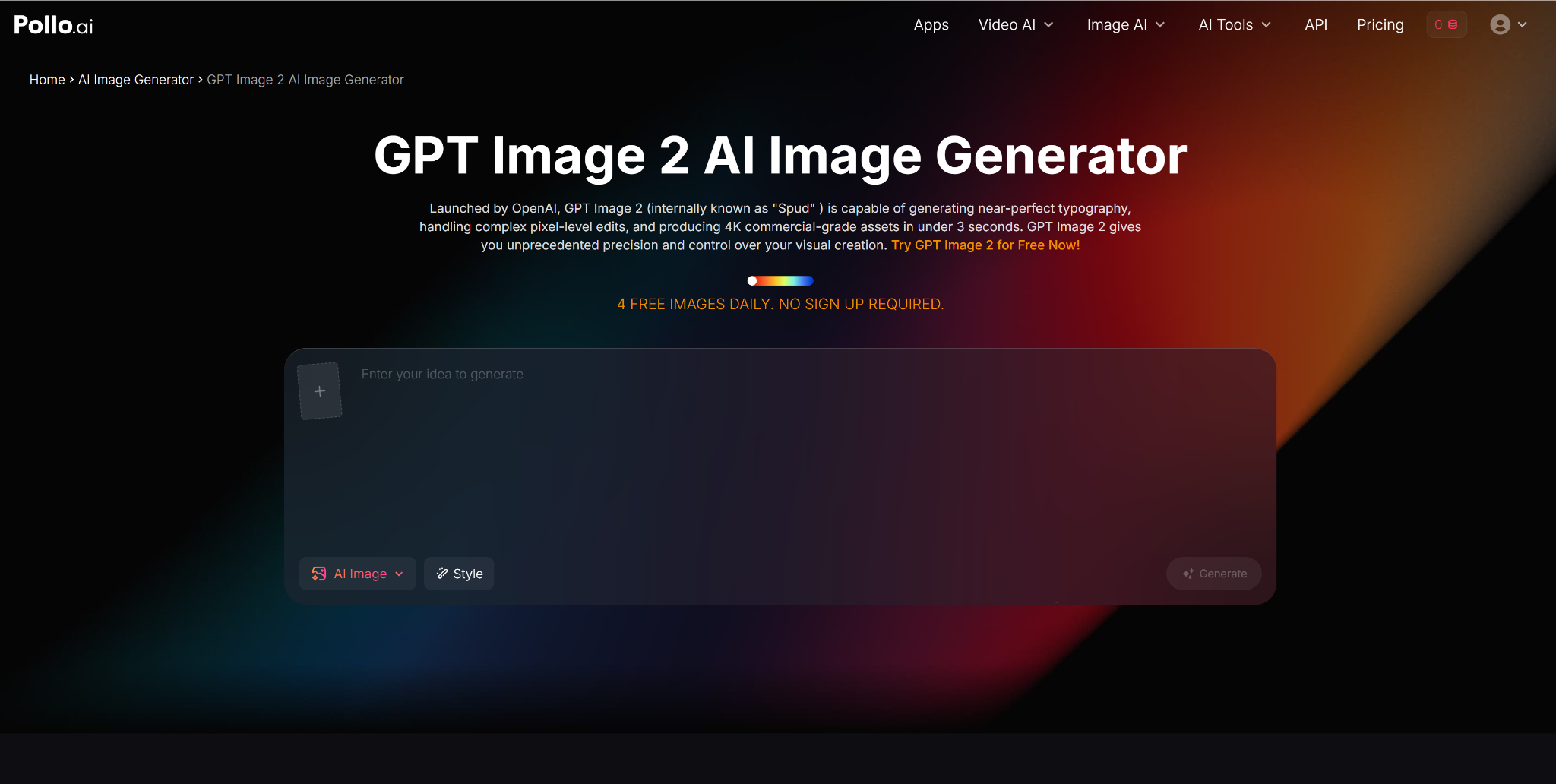
If you want to get hands-on with ChatGPT Images 2.0 without navigating multiple platforms, Pollo AI offers access to it directly through its all-in-one creative hub.
Pollo AI brings together some of the most powerful AI image and video generation tools in one place, making it easy to experiment with Images 2.0 alongside other leading models and find what works best for your specific creative needs.
The Competitive Landscape Just Shifted
It would be naive to discuss ChatGPT Images 2.0 without acknowledging what it means for the broader competitive landscape.
Midjourney, Stable Diffusion, Adobe Firefly, and other leading image generators have all been working on the text rendering problem with varying degrees of success. OpenAI just set a new benchmark, and the pressure on competitors to respond is immediate and significant.
This is the kind of release that forces the entire industry to accelerate. When one player solves a problem that everyone else has been struggling with, it doesn’t just raise expectations for that tool — it raises expectations for every tool.
Users who have accepted blurry, inaccurate text as an unavoidable limitation of AI image generation now know that it doesn’t have to be that way. That knowledge changes what they demand from every platform they use.
What This Means for Creative Professionals?
ChatGPT Images 2.0 is a landmark release — not because it’s perfect, but because it solves a problem that has genuinely limited the professional utility of AI image generation since the technology emerged.
Accurate text rendering changes the calculus for marketers, designers, content creators, and business owners who have been keeping AI image tools at arm’s length precisely because of this limitation.
If you haven’t tried it yet, now is the time. The gap between what AI image generation promised and what it could actually deliver just got a lot smaller — and the creative possibilities on the other side are worth exploring.
