

Most personalized apps are easy to ignore.
Spotify thinks you will like a song. Netflix predicts what you might watch next. A shopping app quietly rearranges products around what you clicked yesterday.
Sometimes the recommendation is useful. Sometimes it is completely wrong. Either way, the interaction rarely stops you in your tracks.
Personalization feels very different when the subject is you.
That difference is visible in a Reddit post about Hint App. The author had downloaded the astrology app after seeing it mentioned online, expecting fairly ordinary horoscope content.
After entering their birth information, they received a longer personalized interpretation about relationships and emotional patterns.
One sentence about feeling the need to be perfect so people would not leave made them stop scrolling.
The author says the app did not solve their problems. What stayed with them was the experience of seeing a familiar private thought expressed clearly outside their own head.
From a technology perspective, that moment is more interesting than whether somebody believes in astrology.
It shows what happens when digital personalization moves from recommending something to us to describing something about us.
A Different Kind of Personalization
The modern internet already knows how to personalize quantity.
More of the music you play.
More products similar to the ones you viewed.
More videos connected with topics you watch.
Self-reflection products personalize something more sensitive: interpretation.
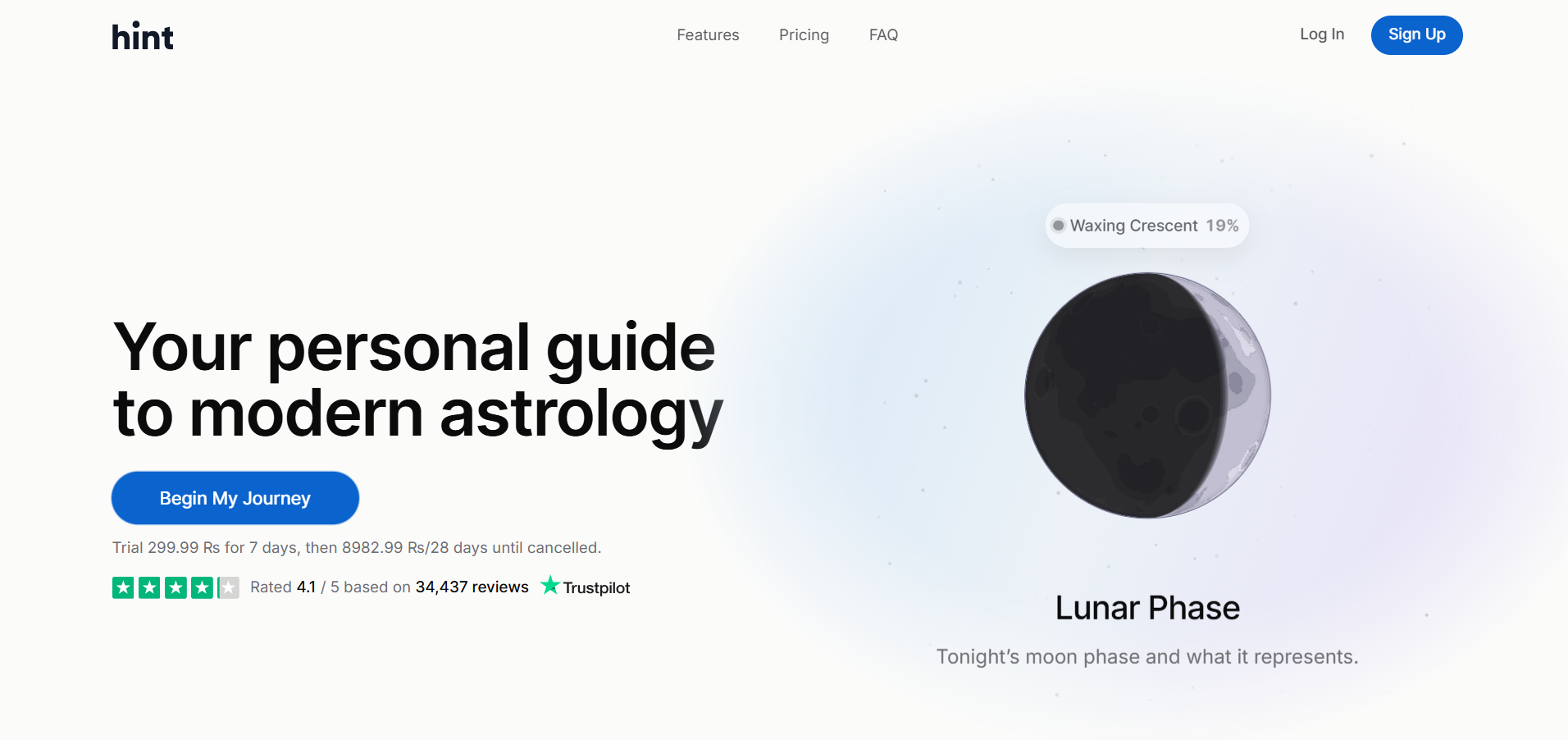
Hint says its personalized astrology uses the exact time, date and place of birth, combining astronomical data with its AI engine and material developed with professional astrologers. Its current service includes individualized birth-chart interpretations and other personal astrology resources.
The experience therefore starts from a familiar interface pattern.
Input personal data → receive an individualized output.
What changes is the nature of the output.
A streaming recommendation says, effectively:
You may enjoy this.
A personalized self-reflection product can feel closer to:
This may describe you.
That small shift gives the result much more emotional weight.
Anatomy of the Pause
The interesting part of the Reddit story happens in only a few seconds.
The user is scrolling.
One sentence appears.
Scrolling stops.
Why does one line land when dozens of others might disappear immediately?
There are several pieces working together.
The input feels specific.
The user has already supplied information connected with their own identity. They therefore expect the output to differ from something written for a general audience.
The subject is personally important.
The interpretation concerns relationships and a fear the writer says they had already thought about many times.
The wording connects with existing self-knowledge.
The sentence does not introduce an entirely unfamiliar idea. It gives a concise form to something the person already recognizes.
The timing is unusually receptive.
The author describes having had a difficult week and reading the app while lying awake. The same wording encountered in another context might have produced a weaker reaction.
None of those factors alone explains the response.
Together, they make the content difficult to treat like another disposable piece of mobile text.
Why “About Me” Information Sticks?
Psychology has a useful concept for part of this effect.
Research on the self-reference effect has repeatedly found that information processed in relation to ourselves tends to be remembered better than material processed in less personal ways.
A major meta-analysis concluded that self-referential processing improves memory in part because people already possess rich, frequently used knowledge structures about themselves.
Later work has also found benefits for remembering specific details when information is processed with reference to oneself.
This does not mean that a personally memorable statement is automatically true.
It helps explain why it can command attention.
Consider these two sentences:
“Some people work hard to avoid rejection.”
and
“You may feel that you have to be perfect so people will stay.”
The underlying subject is similar.
The second invites an immediate comparison with autobiographical experience.
Have I done this?
Which relationship does this remind me of?
Would I describe myself that way?
Once those questions begin, the user is doing much more cognitive work than simply reading another sentence.
The App Produces the Text. The User Supplies the History.
This is the part that is easy to overlook when discussing AI personalization.
A system can generate or select individualized content, but the system does not bring the user’s lifetime of memories to the screen.
The user does.
A sentence about overthinking relationships may connect with five conversations, an old breakup, a childhood memory or something somebody said last week.
Another user could read exactly the same idea and feel almost nothing.
The emotional force therefore comes partly from the information already stored on the other side of the interface.
This is one reason perceived relevance has such an important role in personalized digital experiences. Research across personalization contexts consistently treats relevance as an important contributor to engagement, although effects differ according to product, setting and the way personalization is implemented.
For Hint App, the birth-chart format creates an especially direct invitation to make that comparison.
The content arrives with the premise:
this reading concerns you.
The user then decides how much of themselves they recognize inside it.
Timing Is Part of the Product Experience
Product designers can control interfaces, copy and algorithms.
They cannot completely control the moment in which somebody opens the app.
That matters more for emotional products than it does for many ordinary utilities.
A weather app telling you it will rain at 4 p.m. has roughly the same practical meaning whether you are in a good mood or a bad one.
A statement about relationships can land differently depending on what happened that day.
The Reddit author explicitly describes being emotionally worn down before opening Hint App. They had been withdrawing from messages, going through their normal routine and lying awake when they encountered the reading.
That context should make us cautious about attributing the entire reaction to personalization technology.
The app supplied the sentence.
The moment supplied part of its intensity.
Digital products rarely know the full circumstances in which their content is consumed.
A person may open the same feature casually at lunch or during a sleepless night.
For developers of highly personal consumer technology, those are technically identical sessions.
For the person holding the phone, they are very different experiences.
Why the Reaction Matters More Than “Accuracy”
It is tempting to reduce a story like this to:
Was the reading accurate?
That question is too narrow.
There are at least two different things a user may be evaluating.
One is factual or predictive credibility.
The other is whether the content prompted useful reflection.
The Reddit author makes no claim that Hint App suddenly provided a complete explanation for their life. They explicitly say that nothing was fixed.
The significant event was recognition.
A sentence articulated something they had already thought many times.
That creates a more realistic way to evaluate personalized reflection products.
Instead of asking only:
- Did it correctly define me?
a user can also ask:
- Why did I react to this?
- Which experience did it remind me of?
- Which parts clearly do not fit?
Those questions preserve the user’s own judgment.
They also prevent a generated interpretation from acquiring more authority simply because it felt emotionally precise.
Good Personalization Leaves Room for Disagreement
A system that describes the user faces an unusual design problem.
Strong personalization can increase relevance.
Too much certainty can make interpretation feel definitive.
The healthier design space leaves room for the person to disagree.
Hint currently describes its service as personalized astrology and states that its astrological readings are for entertainment purposes rather than substitutes for professional advice.
That boundary is especially important with emotionally charged material.
A personally meaningful line can be worth thinking about without being treated as a diagnosis.
A user can keep one observation and dismiss another.
They can bring a thought into a conversation with someone they trust.
They can decide that a description feels accurate without assuming the mechanism behind it has established a psychological fact.
Personalization works best here when it encourages inspection rather than obedience.
What Hint App Shows About Consumer Technology?
DigitalEdge frequently covers the way personalization has moved deeper into ordinary digital life, from entertainment recommendations to services that adapt around user interests and behaviour.
Hint App illustrates a particularly intimate version of the same development.
The personalized internet once concentrated largely on predicting what users might click, buy or watch.
Consumer apps now increasingly personalize material concerned with identity, relationships and self-reflection.
That changes the stakes of a successful recommendation.
If Spotify correctly predicts a song, the reward is a good three minutes of music.
When an app produces a sentence someone feels describes a private pattern in their life, the response can be considerably more personal.
The Reddit story does not prove that an app understood its user completely.
It demonstrates something subtler about digital personalization.
The strongest moment may occur when technology produces just enough relevance for the user to finish the interpretation themselves.
The screen provides a sentence.
The person supplies the memory behind it.
Sometimes that is enough to make the thumb stop scrolling.
