

The architectural framework of digital discovery has undergone a seismic shift. In the preceding era of search, visibility was largely a function of keyword density and backlink profiles.
However, Large Language Models (LLMs) have introduced a new layer of complexity: the semantic layer. Today, a brand’s digital presence is judged solely by its ability to exist within the conceptual map of an AI space.

When a brand fails to appear in AI-generated responses despite possessing relevant products or services, it is often due to a “semantic gap.”
Understanding how LLM tools identify and rectify these gaps is now a critical competency for digital strategists.
Defining the Semantic Gap in AI Architectures
A semantic gap occurs when there is a misalignment between the data a brand provides and how an LLM perceives that information in a broader context.
Unlike traditional search engines, which rely on indices, LLMs process information as high-dimensional vectors, known as embeddings. In this environment, “meaning” is determined by the mathematical proximity of concepts.
If a brand’s messaging is fragmented or lacks structured entity definitions, it may be positioned too far from the user’s query in the vector space.
LLM tools are designed to diagnose these mathematical misalignments. By analyzing the output of various models, these tools can pinpoint exactly where a brand’s documentation fails to provide the “signal” the AI needs to recognize it as a relevant authority.
How LLM Tools Identify Visibility Deficits?
The methodology employed by professional LLM tools to detect these gaps is rigorous and multifaceted. It moves beyond simple ranking reports to offer a diagnostic view of brand perception.
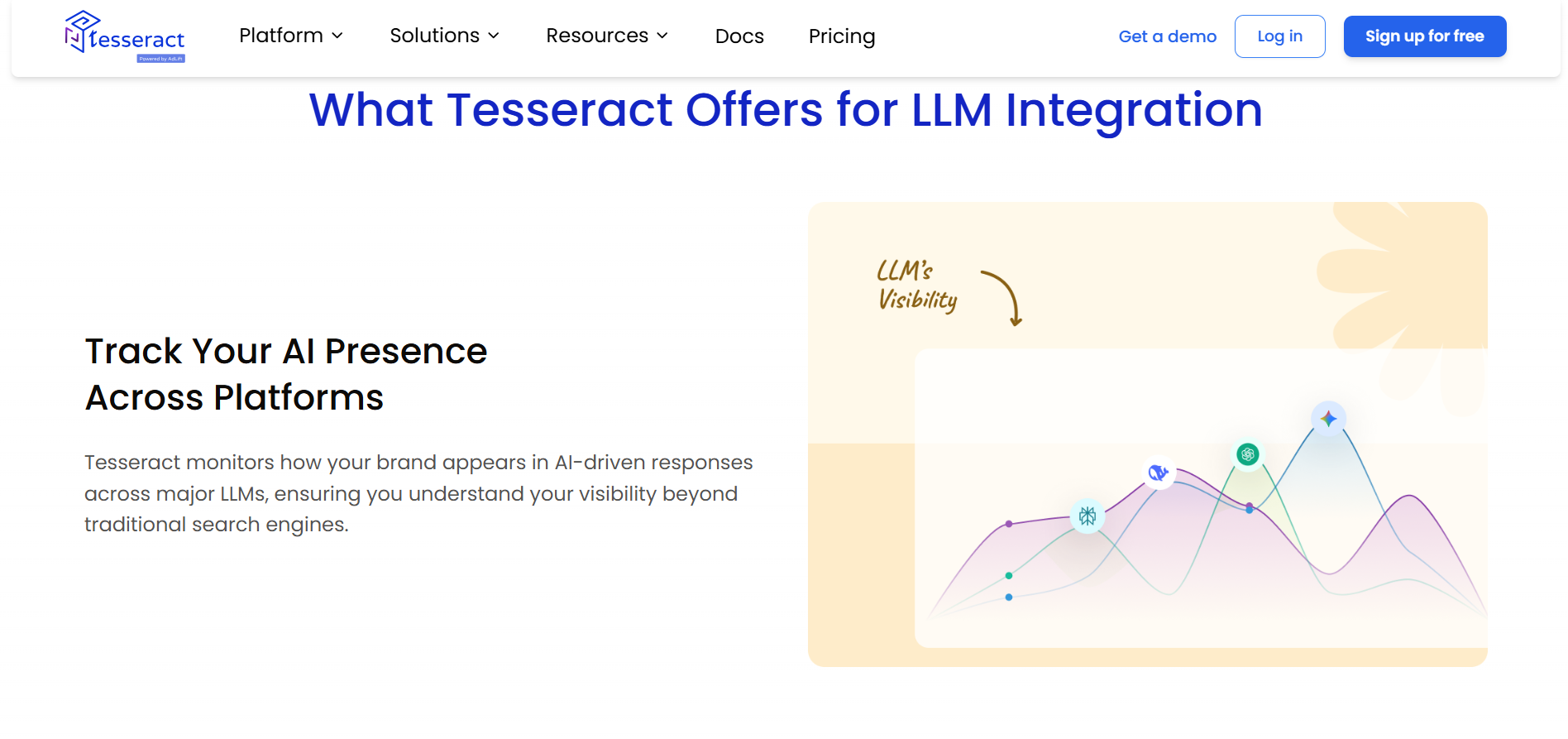
- Prompt Simulation and Probability Analysis: LLMs are probabilistic engines. Modern LLM tools run thousands of simulated user queries to determine the frequency and accuracy of a brand’s mention. If a brand appears inconsistently across multiple samples, a visibility gap is identified.
- Entity Mapping and Attribution Gaps: AI models rely heavily on entities, distinct concepts such as “Product Name,” “Manufacturer,” or “Industry Solution.” LLM tools evaluate whether a brand’s content effectively establishes these links. A gap exists if the AI can describe a solution but fails to attribute it to the specific brand.
- Contextual Relevance Scoring: By measuring “cosine similarity” between a brand’s published content and the AI’s training data, LLM tools can determine whether a brand uses the language of its industry or is linguistically isolated.
The Strategic Importance of Closing the Gap
The cost of a semantic gap is tangible. In an AI-first environment, the model often acts as a gatekeeper, distilling vast amounts of information into a single, authoritative recommendation.
If a brand is excluded from this distillation process, it effectively ceases to exist for a segment of the audience that relies on AI for decision-making.
Furthermore, LLM tools highlight where misinformation or “hallucinations” occur. When an AI provides incorrect details about a company’s services, it is often because the brand has not provided clear, machine-readable data that the model can prioritize.
By using LLM tools to audit these responses, organizations can implement targeted content interventions to correct the model’s understanding.
Structural Optimization for AI Interpretation
To bridge these gaps, LLM tools frequently advocate for a transition from “content for humans” to “content for both humans and machines.”
This involves the aggressive use of structured data and Knowledge Graphs. By defining relationships between concepts in a format that AI can easily parse, brands can reduce ambiguity and avoid semantic gaps.
Moreover, the frequency of model updates means that visibility is not a static achievement. Continuous monitoring via LLM tools is required to ensure that, as models are retrained or fine-tuned on new datasets, the brand’s semantic clarity remains intact.
This proactive approach ensures that the brand’s “information gain”, the unique value it provides beyond common knowledge, is consistently recognized by the AI.
Navigate the New Visibility Frontier Effecively
The transition from keyword-based search to semantic-based AI discovery requires a fundamental shift in how brands approach their digital footprint. Identifying the semantic gaps that obscure brand visibility is a prerequisite for survival in a sophisticated digital economy.
As organizations seek to master this new domain, they require specialized infrastructure to interpret the nuances of AI perception.
By using advanced LLM tools like Tesseract to connect brand messaging with AI understanding, your organization can stay visible, relevant, and authoritative in an increasingly automated world.
