

Growing a beauty brand creates a problem that many founders do not anticipate: selling more products also creates more work. Every new order needs processing. Inventory must stay accurate.
Customers expect shipping updates, and new products require descriptions, packaging, and supplier coordination. At some point, the founder spends more time managing operations than building the business.
Hiring can solve part of the problem, but it also adds fixed costs before the business knows how much demand it can sustain. A better starting point is to remove repetitive tasks and avoid taking on work that another company can handle more efficiently.
Selfnamed, a private-label skincare platform, offers one example of this approach. The company draws on two decades of cosmetics experience and provides ready-to-brand beauty products, store integrations, and order fulfillment.
Rather than developing every formula and managing every shipment internally, entrepreneurs can focus on branding, marketing, and customer acquisition.
The same principle applies to the rest of an ecommerce operation: automate routine work, outsource selected responsibilities, and build systems that can handle additional orders without requiring someone to manage every step manually.
Why Small Beauty Brands Hit an Operational Ceiling?
A small skincare business might begin with three products and a manageable number of weekly orders. The founder can check inventory manually, answer customer emails, and prepare shipments without much difficulty.
The situation changes when the business introduces more products or starts selling through additional channels. A serum, cleanser, moisturizer, and face mask each need accurate product information, pricing, stock records, and fulfillment arrangements. Selling through a website and a marketplace adds another layer of coordination.
These tasks rarely appear significant in isolation. Together, they can consume several hours each day.
The cost is not limited to labor. Manual processes also create opportunities for mistakes: incorrect stock levels, delayed shipments, duplicated orders, and inconsistent product information. Those errors can damage the customer experience just as the business begins attracting more buyers.
The goal is not to automate everything. It is to identify which activities repeat frequently, follow predictable rules, and do not require human judgment. Those are the best candidates for automation.
1. Automate Order Processing and Customer Communication
Order processing is one of the most straightforward places to start.
Without automation, a founder may need to review incoming orders, transfer details to another system, notify a supplier, update inventory, and send customers shipping information. Repeating those steps for every purchase wastes time and increases the risk of errors.
A connected ecommerce setup can handle much of this work automatically. Once a customer places an order, the system can pass the order details to the fulfillment provider, update the order status, and trigger confirmation and shipping emails.
For a small beauty brand, this means fewer routine tasks between a completed checkout and a dispatched package.
Customer communication can follow the same logic. Automated emails can explain what happens after an order, provide tracking details, and answer common questions. A help center can cover topics such as delivery times, product storage, and return procedures.
There is one important distinction: automation should handle predictable situations, not every customer interaction. A delayed delivery, damaged product, or complaint about a skincare product may require a person to investigate and respond appropriately.
The practical approach is to automate routine communication while making it easy for customers to reach someone when their situation falls outside the standard process.
2. Reduce Inventory and Fulfillment Work With the Right Partner
Software can automate order data, but it cannot eliminate the physical work of manufacturing, storing, packing, and shipping cosmetics. A brand must decide whether to manage those activities itself or work with a partner.
Traditional inventory management gives a business more direct control over stock and dispatch. The trade-off is that the company must pay for products before selling them, find storage space, monitor stock levels, and arrange fulfillment. Unsold inventory can tie up money that might otherwise fund marketing or product development.
An alternative is private-label dropshipping. The business sells products under its own brand, while a supplier handles the relevant production and fulfillment tasks. Depending on the arrangement, orders can move from the online store to the supplier without the seller storing every item or packing each shipment.
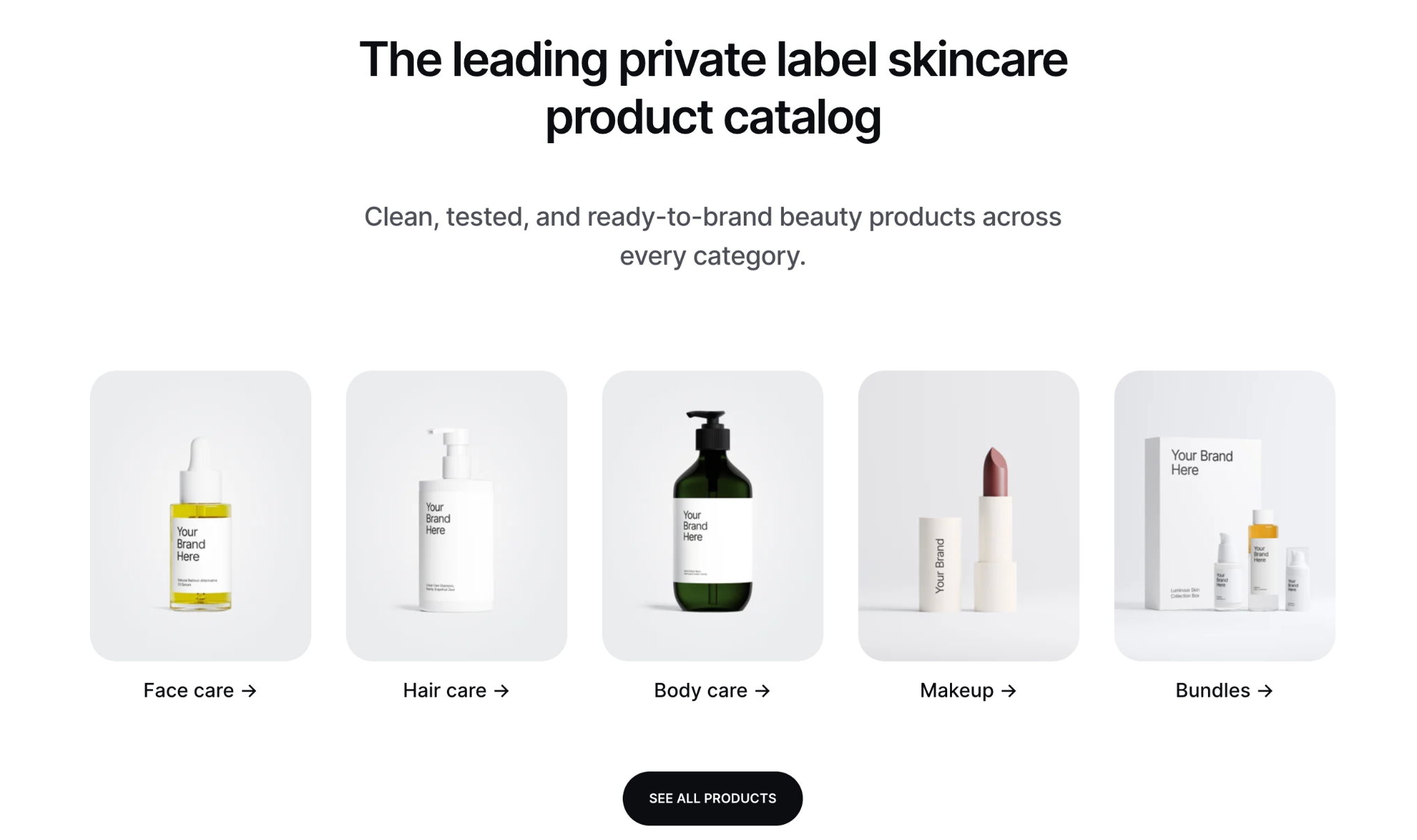
Selfnamed’s skincare platform supports this model. Its catalog includes more than 200 ready-to-brand beauty products, and the company offers store integrations and fulfillment from facilities in Europe and the United States. Its published offering also allows businesses to order individual units for products without minimum order requirements, rather than committing to a large initial production run.
For a founder who wants to launch a skincare line, that can remove several operational responsibilities at once. There is no need to establish a manufacturing facility, and the business does not have to manage every shipment itself.
This model has trade-offs. Per-unit costs may be higher than bulk purchasing, and the seller has less direct control over fulfillment. Delivery times, packaging options, product quality, and the supplier’s return procedures still need careful evaluation.
The right choice depends on the business. A new brand testing demand may value flexibility more than the lowest possible unit cost. An established brand with predictable sales may eventually benefit from bulk ordering and more direct control over inventory.
3. Test Products Before Committing to Large Orders
Expanding a product range can attract new customers, but launching too many products at once creates additional work and financial risk.
Each product needs a clear position in the range, suitable packaging, accurate descriptions, pricing, and a plan for reaching customers. If the product does not sell, the business may be left with stock that takes months to clear.
A smaller initial range makes it easier to learn what customers actually want. A skincare brand might begin with a cleanser, moisturizer, and serum, then use sales data and customer feedback to decide which products deserve further investment.
Private-label manufacturing can make this approach more accessible because a brand can use existing formulations rather than fund custom product development from the beginning.
Private-label manufacturers offer ready-made formulas that entrepreneurs can customize with their own branding. Its product catalog and platform are designed to let businesses select products, create packaging, and sell under their own names.
The company also offers bulk ordering, so brands can consider a different purchasing model as demand becomes more predictable.
This is useful because product development and brand building are separate activities. A business does not necessarily need to develop a formula from scratch to establish a recognizable identity. It can differentiate itself through its target audience, product selection, visual identity, positioning, and customer experience.
However, a low barrier to launching products does not guarantee demand. Founders still need to check product quality, understand ingredient and labeling requirements in their target markets, calculate margins, and test whether customers are willing to pay the proposed price.
4. Automate Marketing Without Losing the Personal Touch
Marketing often becomes another bottleneck as an ecommerce business grows. A small team cannot manually follow up with every visitor, remind every customer about an abandoned cart, or send individual messages after each purchase.
Email automation can help manage these interactions.
A welcome sequence can introduce the brand to new subscribers. An abandoned-cart email can remind a shopper about products they considered. A post-purchase sequence can provide product instructions and explain how to use items correctly.
For beauty brands, the content matters as much as the automation. Customers may need guidance on how products fit into a routine, how to introduce a new product, or how to store it. Helpful information can strengthen the customer experience without requiring the team to answer the same questions repeatedly.
Replenishment reminders can also be useful when the timing makes sense for the product and the customer has agreed to receive marketing messages. They should not assume that every customer uses a product at the same rate.
Automation also needs sensible limits. Sending too many emails can lead to unsubscribes and weaken trust. Messages should be relevant, accurate, and easy to opt out of.
The aim is to make good customer communication repeatable, not to replace a brand’s personality with generic messages.
5. Build a Lean Ecommerce Tech Stack
More software does not automatically mean a more efficient business. Adding separate tools for inventory, email, order management, customer support, and analytics can create another problem if those systems do not share information.
A small beauty brand should start with a manageable setup:
- An ecommerce platform to manage products, checkout, and customer orders.
- A supplier or fulfillment partner that can work with the store’s existing systems.
- An email marketing tool for customer communication and retention.
- Basic reporting to track sales, costs, margins, and fulfillment performance.
Integrations matter because they reduce the need to transfer information manually. If an order arrives in the online store but must be copied into a separate fulfillment system, the business still depends on someone to bridge the gap.
For founders considering a similar setup, the lesson is broader than choosing a particular supplier: evaluate whether each tool removes work across the process or simply adds another dashboard to manage.
Start with the workflows that cause the most friction. Add software only when it solves a specific problem, and check that the new system works with the tools already in place.
A Practical 30-Day Plan for Scaling Without Hiring
A small brand does not need to rebuild its entire operation at once. A month is enough to identify a few repetitive tasks and make measurable improvements.
Week 1: Map the workload. Record recurring tasks and estimate how much time they take. Include order processing, customer emails, stock checks, supplier communication, and fulfillment.
Week 2: Automate the basics. Set up order confirmations, shipping notifications, routine email sequences, and inventory alerts where the existing systems support them.
Week 3: Review the physical operation. Compare the cost and workload of holding inventory with the available fulfillment options. If product development or shipping consumes too much time, assess whether an external partner could take over those responsibilities.
Week 4: Measure the results. Compare time spent on routine work, order errors, fulfillment times, customer inquiries, and contribution margin before and after the changes.
The financial measurement matters. An automation that saves two hours a week may still be worthwhile, but its value depends on the cost of the tool, the importance of the time saved, and whether it improves the customer experience. Outsourcing can reduce workload while also changing product costs and margins.
Use the results to decide what to improve next. Do not add tools or outsource tasks simply because other brands do so.
Scale the System Before Scaling the Team
A growing beauty brand does not need to handle every part of its operation internally. Order processing, routine customer communication, and stock updates are often suitable for automation. Manufacturing, storage, and fulfillment may be better handled by a specialist, depending on the business model.
The important decision is to understand which activities create value for the customer and which simply consume time.
Automate the repetitive work, choose partners carefully, and measure the results. That gives a small team more room to focus on the parts of the business that actually drive growth.
