

Publishers can struggle with both audience growth and monetization. Myths about traffic thresholds, quoted rates, and ad density make it harder to identify which problem needs attention. Testing those assumptions is more useful than adding tags or chasing pageviews indiscriminately.
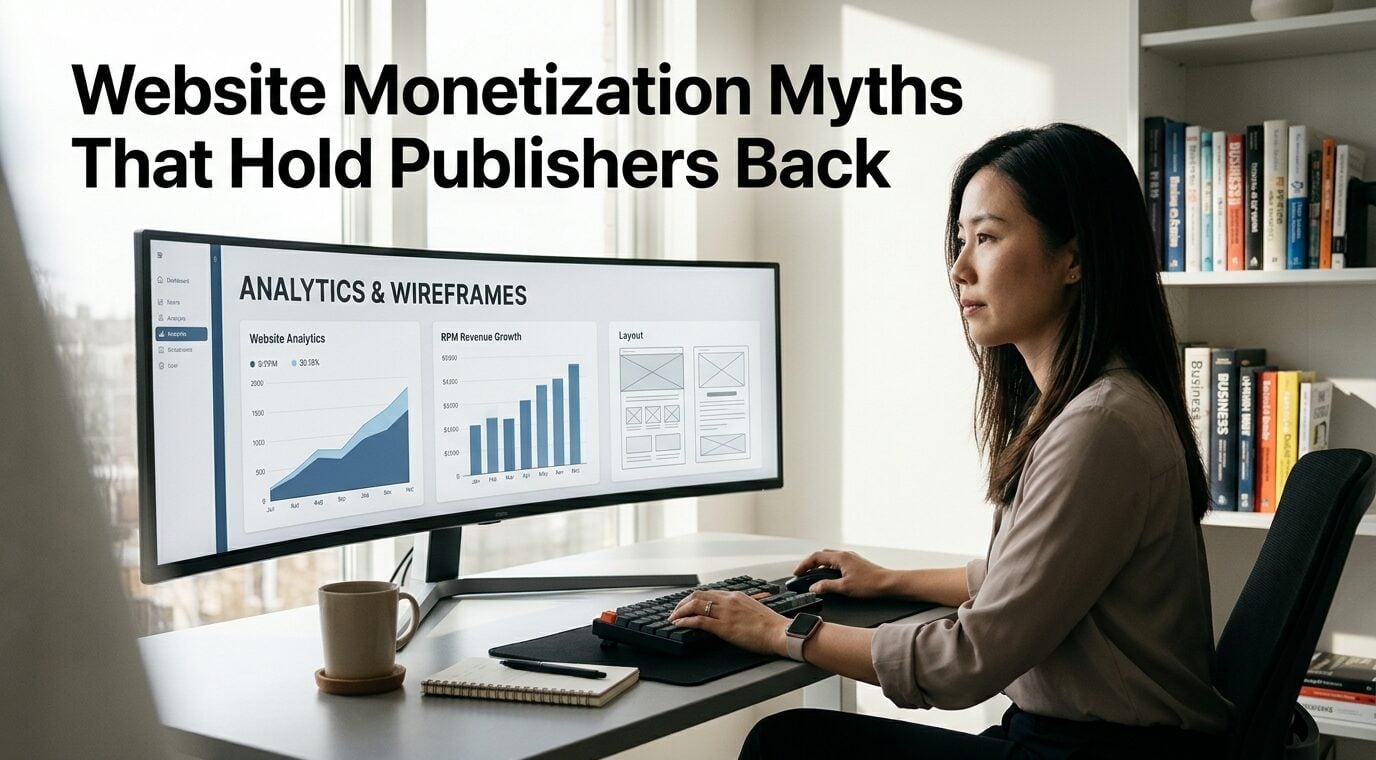
You don’t need six figures of traffic to earn real money
The traffic myth is sticky because it feels logical. More visitors should mean more money. But advertisers pay for access to potential buyers, not pageviews alone.
In a hypothetical comparison, a smaller specialist tool may earn more per thousand pageviews than a larger general-entertainment feed.
The result depends on audience geography, demand, format, and actual engagement, not just visitor counts or a niche label. That gap comes down to niche traffic and geographic targeting.
A general entertainment site might pull huge totals and still post a weak RPM. That’s revenue per mille, or earnings per 1,000 pageviews. A narrow site about tax software or VPNs can’t match that volume. It doesn’t need to.
Each visitor arrives with clear intent, and advertisers pay a premium to reach that intent in geos where budgets are dense.
Traffic from the United States or the United Kingdom often draws bids far above those for mixed global traffic. Intent and location can change revenue per visit substantially, while total traffic still affects the amount a site can earn.
Publishers stuck on volume chase the wrong goal. They add slideshow pages and thin news posts to lift pageviews. Those pages drag down time on site and dilute intent. RPM slips even as totals climb.
More ad slots don’t mean more revenue
New publishers often stack banners above the fold and in every sidebar gap. The logic is simple: if one banner pays, five must pay five times more.
That math is wrong. Each extra unit fights for the same attention and the same budgets, so average viewability drops and advertisers lower their bids for the whole page over time.
Viewability is now a core quality filter. If ads sit below the fold or load in cluttered rails, few get seen. Buyers notice and shift spend to cleaner sites with two strong placements rather than six weak ones.
A crowded page also slows loading and pushes readers to bounce before the second impression even counts. One fast page with a sticky footer and a matched in-article unit will often beat a stuffed page on total RPM.
Publishers that cut from five units to two often see session length rise while revenue holds steady or climbs, because the remaining impressions sell at higher prices. Fewer, cleaner slots protect the reader behavior signals that buyers pay for.
AdSense isn’t the only respectable option
Google AdSense is the default for a reason. It offers a familiar route to display monetization, subject to eligibility, review, and payment terms. Still, it won’t be the best fit for every site.
Specialized networks pull bids from several exchanges at once and pair them with formats that fit specific behavior, like native units for content feeds or direct-click tools for utility sites.
Additional demand may improve results, but a single tag can itself connect to multiple buyers. Compare realized earnings and operating costs rather than inferring demand breadth from the number of tags.
Header bidding lets multiple buyers compete before the ad-server decision. It may improve demand for a slot, but extra scripts, fees, and latency can offset gains. Test net results rather than assuming that competition always raises publisher revenue.
Yield climbs when the format fits how visitors use a site. A download portal needs different logic than a recipe blog, and one tag can’t serve both well.
The gap shows up fastest on tool sites and entertainment blogs where standard display alone underpays. Small publishers feel the ceiling first, with long support queues and generic optimization advice. A partner built for smaller sites will look at actual pages, not averages.
Publishers comparing alternatives often shortlist a top ad network for publishers that can match demand and format to niche and geo rather than forcing the same banner everywhere.
An account manager may help interpret placement and country splits. A test still has costs: implementation time, possible revenue variation, and any contractual restrictions. Confirm exclusivity and compatibility before adding a second demand source.
Run a second demand source for two weeks and compare realized earnings per thousand, not promises made during a sales pitch.
A high headline CPM doesn’t mean a good partner
Networks love to quote a big CPM. Publishers love to hear it. The number on the sales sheet isn’t what lands in the account.
Separate impression eCPM from request-level yield. Impression eCPM is finalized publisher revenue divided by paid impressions, multiplied by 1,000. Request-level revenue uses all ad requests as its denominator, including unfilled ones.
A flashy headline rate on thin fill pays less in practice than a modest rate that actually clears on almost every impression.
Track realized revenue per thousand requests after fees alongside impression eCPM and fill rate. If a request-level metric already includes unfilled opportunities, multiplying it by fill rate again double-counts the same effect. Keep denominators consistent across partners.
Fill rate is the share of ad requests that return a paid impression. Header bidding and multi-exchange demand lift fill because more buyers see each slot. Single-source tags leave gaps that earn zero.
Geo mix complicates the picture further. Demand is dense in some markets and thin in others, so two sites with the same traffic can post very different RPMs.
Smart publishers ask for eCPM by country and device before signing anything. That table gives a clearer picture. Ask how fees are taken and when unfilled slots still cost nothing. Clear answers beat vague rate cards.
Interruptive formats don’t always wreck user experience
Pop-unders have a bad name, and some of it is earned. Done wrong, they annoy.
A permitted, frequency-capped implementation may provide another revenue source for some entertainment or tool sites. Compare total earnings, complaints, and repeat visits; no format is inherently more profitable than standard banners.
Frequency capping limits interruptions, and geo targeting keeps ads relevant. Entertainment traffic in late evening responds very differently than morning news traffic.
The cap is everything. One pop per day per visitor behaves very differently from three in a session. Niche match matters too.
A streaming guide that opens a relevant subscription trial converts attention into value. A random auto-play video on a recipe page just irritates.
Native units can play the same role on content sites. They blend into feeds where banners get ignored. How well a format fits matters more than its name.
Publishers should test bounce and session time for two weeks with and without the format. If repeat visits hold steady, the fear was louder than the fact.
Data beats gut feel.
Test one capped placement at a time so results stay clean.
Direct deals aren’t always better than networks
Selling direct sounds ideal: keep the full rate and skip the middleman. Reality is messier for a solo team.
Direct buyers rarely take all impressions across all geos and devices, so unsold inventory sits empty unless a network backfills it automatically behind the direct tag.
An ad exchange behind the page solves that gap by auctioning leftovers to dozens of buyers in milliseconds. Additional demand may fill some otherwise unsold impressions, but full coverage is not guaranteed and depends on price floors, eligibility, and buyer interest.
There is also sales overhead. Outreach and invoicing eat hours that could go into content. Networks absorb that work for a cut.
Late payments sting most when traffic is small. One delayed invoice can wipe out the hosting budget for the month.
The best setup for many midsized sites is hybrid. Sell the homepage takeover direct and let programmatic fill the rest.
That mix keeps control without leaving money in empty slots. Yield stays high without the same demands on a publisher’s time.
Publishers don’t have to pick a side. Use direct for premium takeovers and sponsors that value context, with networks handling remnant scale. The blend often pays best. Keep one direct slot open for tests while networks cover the base. That combination of stability and upside is hard to beat.
Monetization isn’t passive income after one tag
Paste a tag and watch revenue roll in. That’s the pitch. It rarely holds for more than a month.
Demand shifts by season and device, so placements that won in December can sag in February while new bidders quietly pay more for other units.
Mobile ratios keep moving too, and a layout built for desktop will leak earnings on phones. Regular checks catch that drift early.
Yield optimization is the unglamorous work that addresses those changes. It means scheduled tests of density, refresh rules, price floors, and geo splits.
A good account manager shortens the cycle. They see what works across similar sites and flag placements that hurt viewability.
They might suggest moving an in-article unit higher or swapping a low-viewability rail for a sticky anchor. Small moves add up.
Publishers that treat monetization as a monthly habit, testing one change and keeping winners, see RPM climb in steps. Those that set and forget watch it fade.
Set a calendar reminder to review RPM by placement and device once a month. Change one variable and keep what worked.
Ad blockers don’t make every monetization model impossible
Ad blockers can affect native ads, conventional banners, and other units. A format name or first-party serving path does not guarantee that an ad will appear. Avoid planning revenue around defeating a visitor’s preference or assuming that an entire niche uses fewer blockers.
Instead, measure the ad opportunities actually available to the site, using privacy-respecting methods. Compare requests, rendered impressions, and finalized revenue with clear denominators.
A gap between pageviews and ad delivery can also reflect consent choices, loading failures, or unfilled demand, so do not label every gap as blocking.
Publishers can diversify with clearly disclosed sponsorships, subscriptions, or relevant affiliate content when those models suit readers. Each has its own costs and responsibilities. A readable page and transparent choices support trust even when some visitors never receive a display ad.
Payment timing matters as much as the headline rate
Even when rates look close, terms decide who can grow. A network that pays monthly with a low threshold beats a higher quote tied to Net-60 and slow tickets.
Small publishers live on cash flow. Reliable payouts and quick answers from support are worth real money when a server bill is due.
Withdrawal flexibility counts too. Low minimums and steady cycles let a growing site reinvest instead of waiting two months to unlock funds.
The market is still huge. U.S. digital ad revenues reached $225 billion in 2023 (IAB/PwC). Small publishers won’t touch most of that, but they don’t need to.
Fix one myth at a time and measure RPM after each fix. Traffic quality beats traffic totals, while realized fill matters more than quoted rates. Steady testing beats set-and-forget tags. That’s how modest sites turn into steady earners.
Start with placement cleanup and a second demand test this month. Gains compound faster than most expect. Myths are sticky, but numbers move once the setup matches reality. Publishers that fix fundamentals first get more from any partner they pick next.
