

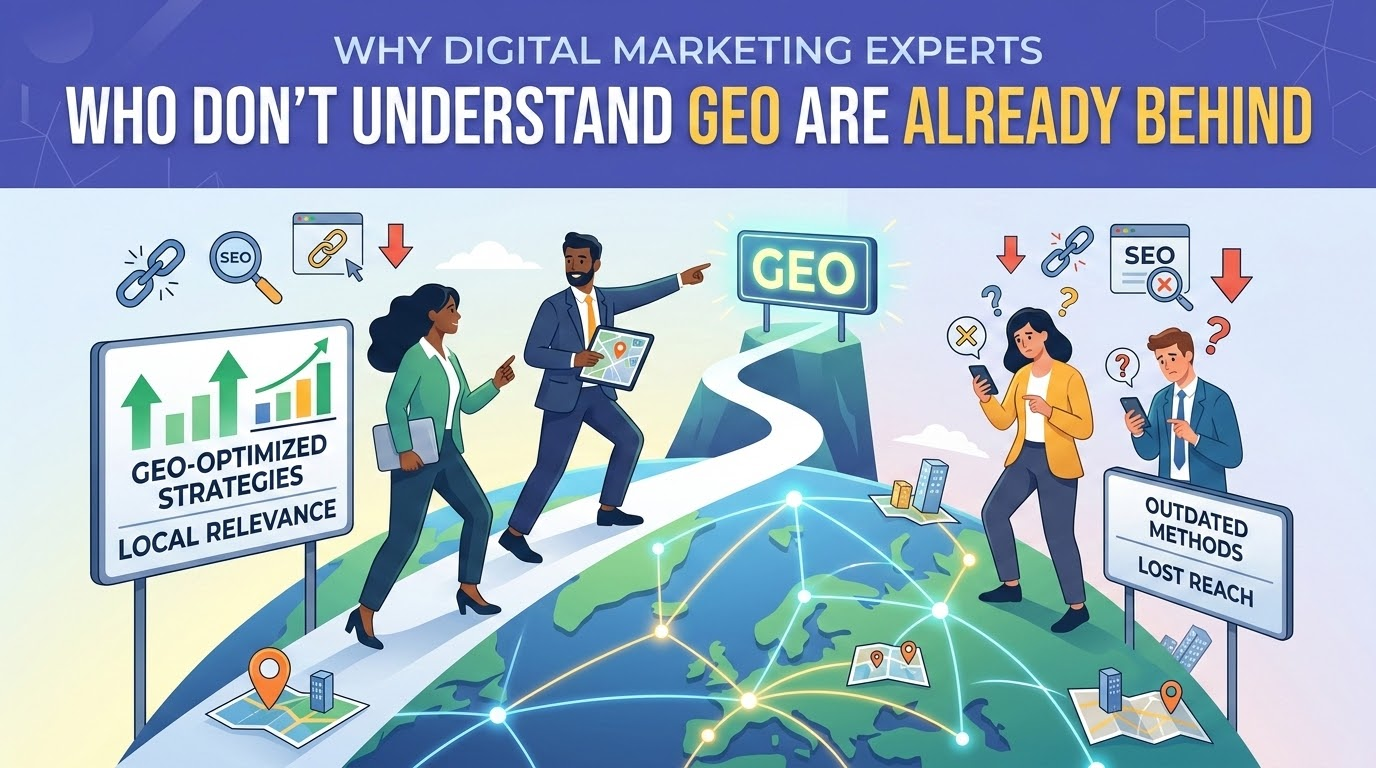
AI-driven search is quietly reshaping how brands are discovered online. While many digital marketing experts continue to refine traditional SEO tactics, a growing gap is emerging between those adapting to generative engine optimization and those who are not.
Structured data and AI-focused content now determine visibility in ways conventional strategies simply do not. Understanding this shift is no longer optional for anyone serious about competitive relevance.
The Rise of GEO in Digital Marketing
GEO adoption grew 340% among marketing agencies between 2022 and 2024. That number alone signals how quickly the field is moving. At the same time, 67% of Fortune 500 companies now allocate separate budget lines specifically for AI search visibility.
The reason this matters is simple: 52% of searches now surface AI-generated summaries first, according to the BrightEdge 2024 State of SEO report. Local SEO agencies are already reporting measurable traffic reductions when client websites lack geo-optimization.
Brands that have implemented schema markup report 3.2x higher AI citation rates compared to competitors without structured data.
Hyperlocal campaigns using IP targeting show 28% higher conversion rates. These are not theoretical gains. They show up in lead volume and client retention.
What GEO Actually Is?
Generative Engine Optimization is the practice of optimizing content so it gets cited within AI-generated answers across platforms like ChatGPT, Perplexity, and Google’s AI Overviews.
The goal is not to rank in position one through three on a search results page. The goal is to be the source an AI pulls from when a user asks a question.
Traditional SEO and GEO are not the same discipline. They share some overlap, but their objectives, success metrics, and content requirements differ in ways that matter.
| Metric | Traditional SEO | GEO |
| Keyword targeting | Exact match phrases | Question clusters |
| Success measurement | Ranking position | Citation count |
| Content structure | Scannable lists | Concise answer blocks |
| Link building | Domain authority | Entity authority |
| Update frequency | Monthly updates | Real-time data feeds |
Location-based marketing now faces specific pressure here. AI systems pull information from structured sources rather than traditional listings alone. Proximity targeting and geospatial data play larger roles when AI engines decide which sources to reference.
Why Digital Marketing Experts Still Using Traditional SEO Are Losing Ground?
Sites relying solely on traditional SEO experienced a 34% visibility decline in Google’s AI Overviews during Q3 2024, per Sistrix’s analysis of 10,000 keywords. That is not a minor fluctuation. It reflects a structural change in how search surfaces information.
The specific failures show up in predictable ways. One agency found its client earned 67% fewer citations than nearby competitors who had implemented proper structured data.
A service business dropped from 12 monthly leads to 3 after missing proximity targeting keywords in their content.
Another analysis found brands without a question-answer schema missed 89% of eligible featured snippet placements.
Citation-building campaigns often produce zero impact on AI answer inclusion despite significant time investment.
The reason is that answer engines evaluate source credibility differently from traditional search algorithms. Directory submissions do not signal authority to a language model.
Ahrefs data puts it plainly: 41% of featured locations now come only from AI-optimized pages.
The Two Tactics That Separate GEO Leaders from Everyone Else
Structured Data and Schema Implementation
Schema markup gives search engines and AI systems explicit signals about what a business does, where it operates, and how to interpret its content. Without it, that interpretation is left to inference, and inference loses to structured data every time.
The schema types most relevant to location-based marketing include:
- LocalBusiness for address and geo coordinates on proximity marketing pages
- FAQ page for targeting question-based queries about services like geofencing
- How-to for setup guides related to location analytics
- Review with AggregateRating for reputation management
- Service for service area pages
- Organization for brand-level location data
Implementing the LocalBusiness schema with geoCoordinates increased AI citation rates for location-based businesses tracked by Semrush in 2024.
Google Search Console verification confirms whether the schema is properly detected. The Merkle schema generator tool supports businesses of all sizes and offers both free and paid tiers.
Content Optimization for AI Summaries
Answer-first content structures with 40 to 60-word summaries increased AI extraction rates compared to traditional blog formats, per Clearscope’s 2024 content analysis.
AI systems favor content that delivers a direct answer before expanding into supporting detail. That structure also improves performance in featured snippets and voice search results.
Practically, this means:
- Leading with a 2-sentence definition using geo-specific keywords
- Keeping bullet points under 25 words when presenting stats or comparisons
- Building comparison tables for location-based services versus traditional methods
- Adding source citations every 150 words
- Creating standalone answer blocks structured for voice search
Companies like NetReputation, which works across ORM and local visibility for brands and individuals, have written about how answer-engine formatting now affects how businesses appear across AI-generated results. The principle applies across industries.
The Competitive Risk Is Accelerating
Companies without GEO implementation lose 2.3 positions per month in AI visibility rankings. Within six months, that compounds to a 41% market-share gap relative to competitors using location intelligence.
Early adopters gain ground that becomes harder to recover as time passes. Local search visibility is difficult to rebuild once competitors establish dominance in map pack rankings and AI citations. The gap widens because location-based platforms increasingly favor established data sources over newer entrants.
Skipping geospatial targeting also means missing proximity marketing scenarios where consumer location data drives immediate purchase decisions. Those are not recoverable with after-the-fact optimization.
Where AI Search Is Heading?
Google’s March 2025 roadmap indicates that AI Overviews will incorporate real-time location data from consumer location points daily to support hyperlocal query responses. Several other shifts are already in motion:
- Multimodal GEO approaches will combine image recognition with proximity targeting to improve engagement in local searches
- Zero-click attribution models will require updated ROI frameworks that account for visibility without traditional clicks
- Real-time geospatial data integration through Google Ads location targeting API updates will give marketers access to fresher consumer location data
- Voice-first optimization is becoming necessary as more local searches occur through smart speakers
- Predictive audience segmentation using location analytics will help forecast buyer intent days in advance
Gartner predicts that location-based marketing queries will increasingly bypass traditional search engine results pages. The marketers adjusting their strategies now will be positioned ahead of competitors who wait for the shift to become undeniable.
A 30-Day Plan for Digital Marketing Experts Ready to Act
Marketing teams following a structured GEO implementation plan report 156% improvement in AI citation rates and 23% increase in location-based lead generation. The process breaks into four focused weeks.
Week 1: Audit current schema markup using Google’s Rich Results Test on 10 location landing pages. Document gaps and identify pages missing structured data entirely. Most teams discover that 60-70% of location pages lack proper schema during this review.
Week 2: Implement LocalBusiness and FAQ schema on the top five service area pages using the Merkle generator. Prioritize pages with the highest organic traffic. Verify each implementation in Google’s Rich Results Test before moving on.
Week 3: Rewrite three pillar pages using the answer-first format with SurferSEO. Prioritize pages targeting geo-specific keywords relevant to core service areas. Answer-first structures measurably increase the likelihood of citations in AI-generated responses.
Week 4: Set up Google Search Console monitoring for AI Overview impressions and create a bi-weekly citation tracking spreadsheet. Track which pages appear in AI responses and monitor changes over successive two-week periods.
Budget across this process is manageable. Schema tools range from free to approximately $299 annually. Content optimization through SurferSEO runs $89 per month. Analytics setup requires roughly two hours of initial configuration.
The target is a 40% citation rate within 60 days of completing the plan. Track citation frequency, AI Overview appearance rates, and location-based lead volume throughout. Those numbers will show clearly which optimization efforts are working.
