

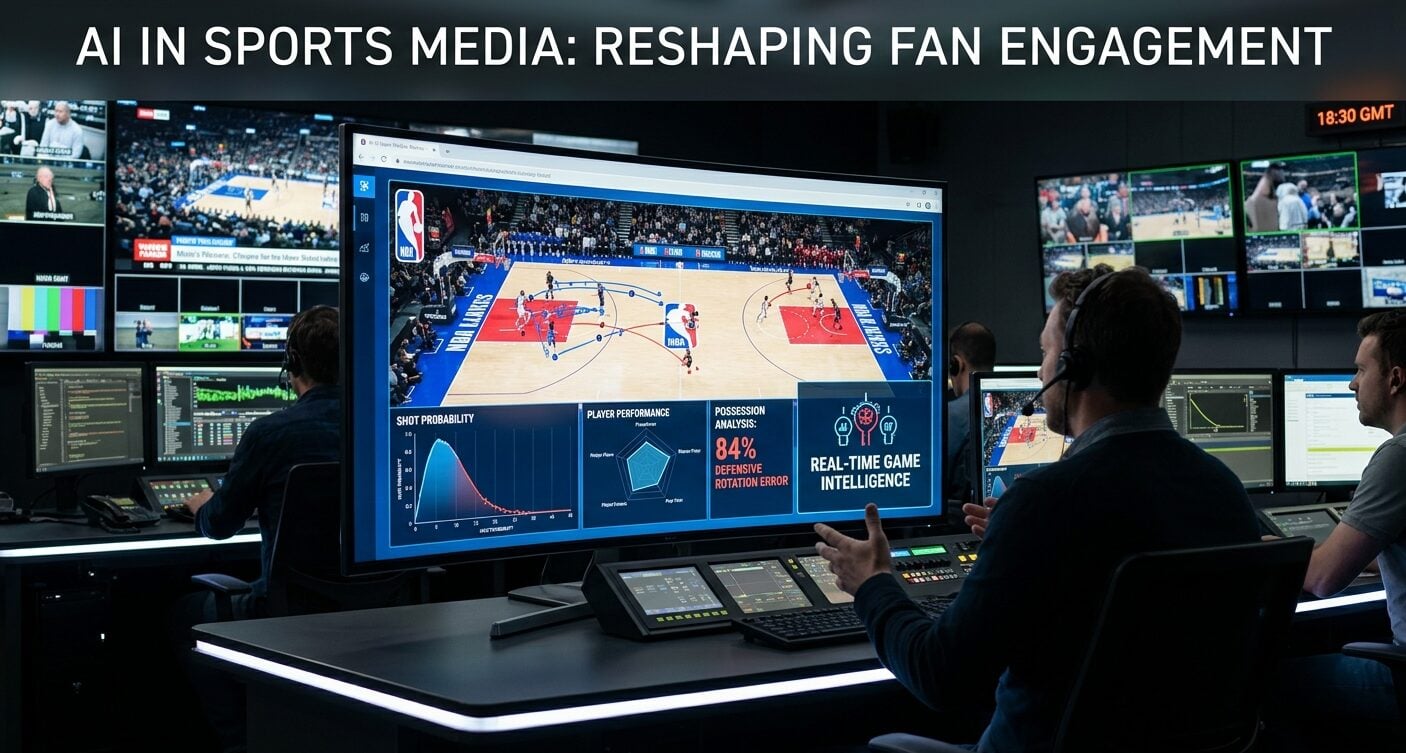
Watch an NBA game today and you’ll notice something broadcasts rarely did a few years ago. A graphic pops up mid-possession showing how rare a shot was, or how a defense just broke down. A moment you would have missed gets explained while it’s still happening.
Behind that graphic sits a mountain of data and a lot of machine learning. Sports media is changing, and the change goes well past flashy overlays.
Here’s what’s actually going on, who it helps, and what publishers and creators can learn from it.
From box scores to movement data
For most of basketball’s history, the data was whatever a scorer wrote down: points, rebounds, assists, fouls. Useful, but it only recorded outcomes. It said nothing about the screen that freed the shooter or the rotation that arrived half a second late.
Tracking technology changed that. Cameras and sensors in arenas capture where the players and the ball are many times per second. The result is a huge volume of information about movement, spacing and shot quality, far more than any person could review by hand.
Machine learning is what makes that volume usable. It can find patterns across thousands of possessions and boil them down to something a viewer can understand in a few seconds.
What AI is actually doing in sports media?
“AI” gets used as a catch-all, so it helps to be specific. A few uses matter most right now.
- Live context during broadcasts. The NBA’s multi-year partnership with Amazon Web Services is the clearest example. AWS is now the league’s official cloud and cloud AI partner, and a platform called NBA Inside the Game turns player-tracking and game data into stats and interactive features for broadcasts, the NBA App, NBA.com and social channels. AWS Insider’s coverage lays out the details. One piece of it, Play Finder, analyzes player movement across thousands of games so a broadcaster can put history next to a live moment.
- Better coverage of the women’s game. The WNBA followed in 2026 with its own version. The league says its AI-powered metrics will highlight things that haven’t been captured before, including how players affect defenses with and without the ball and how difficult each shot really is. The league’s announcement says the metrics will be available in the WNBA App, on WNBA.com and during live games.
- Faster production. Behind the scenes, automation helps tag clips, cut highlights and draft routine recaps. Editors spend less time on busywork and more on the stories that need a person.
- Personalization and language. League apps are aiming for more personalized, in-language content, so a fan in one country doesn’t get the same feed as a fan in another.
What it means for fan engagement?
The biggest winners are probably casual fans. Plenty of people watch a game without knowing why a particular play mattered. A good graphic explains it in seconds, without making anyone feel behind.
Hardcore fans get something too: more granular numbers to argue about. Questions that used to rely on the eye test, like who really bends a defense without touching the ball, now have at least a starting point.
There’s also a second-screen effect. When the app and the broadcast tell the same story, people stay longer and poke around more. That matters to leagues, but it also matters to anyone trying to keep an audience’s attention.
The catch is trust. A metric produced by a proprietary model is hard for a fan to check. When a number is a black box, it can start to feel more like marketing than analysis. The leagues that explain what their new stats measure, and what they don’t, will earn more belief than the ones that just hand over a score.
What publishers and creators can take from this?
You don’t need a league budget to borrow the good ideas. Most of them come down to editorial habits rather than technology.
- Answer one question per piece. Data is only interesting when it settles or sharpens an argument people are already having.
- Use numbers to reframe a familiar debate. Basketball Loop’s explainer, Is Soccer Harder Than Basketball? What the Numbers Actually Say, is a simple example. It takes a question fans already argue about and brings measurable evidence to it, which is a format almost any niche site can copy.
- Automate the routine, keep the voice human. Let software handle clip tagging, data pulls and first drafts of scoreboards. Readers come back for a point of view, and that part can’t be automated.
- Show your sources. One line saying where a number came from does more for credibility than any design upgrade.
- Build a habit, not just a post. A morning email, a weekly preview or a recurring chart gives readers a reason to return without having to be pulled back by social media.
Where it can go wrong?
Every new tool brings its own failure modes. These are the ones worth planning for:
- Confident mistakes. Automated recaps can state wrong facts in a calm tone. Without a human check, errors reach the audience.
- Sameness. When everyone uses the same tools and templates, coverage starts to read the same. Original angles become the thing that stands out.
- Filter bubbles. A feed tuned to what you already like can hide the story you needed to see. Personalization works best when it leaves room for surprise.
- Privacy. Personalization runs on personal data. Fans are more forgiving when they’re told clearly what is collected and why.
- Stat overload. More numbers are not automatically better. A screen full of metrics can make a game harder to follow, not easier.
A simple way to start
If you run a small publication or a creator channel and want to move in this direction without a big investment, this is a reasonable first pass:
- Pick one recurring format. A weekly preview, a Monday recap or a monthly ranking works. Repeating something teaches you faster than launching something new each time.
- Choose one data source and one question. Keep the scope small enough that you can explain it in a sentence.
- Automate the collection, not the conclusions. Let tools fetch and organize numbers. Make the call on what they mean yourself.
- Have a person verify every figure. This takes a few minutes and prevents most embarrassing corrections.
- Watch what readers actually do. Replies, shares and return visits tell you more than page views. Keep what works and drop what doesn’t.
Where this is heading?
Leagues are betting that AI-assisted analytics will make games easier to understand and more fun to follow. Early signs, including the move into women’s basketball, suggest it will keep spreading across leagues and sports.
For media companies, the lesson is less about any single tool and more about what the tools make possible: explaining the game better, faster, and to more people at the same time.
The audience still wants the same thing it always has. They want to feel closer to the game. Analytics and AI are just a new way to get there, as long as the people using them stay honest about what the numbers can and can’t say.
