

Deloitte’s Global Outsourcing Survey 2024, based on more than 500 executives, found that 70% had brought some outsourced work back in-house over the previous five years. A vendor can look right in a pitch and still miss the brief once real work starts.
Casino games make that gap expensive. Math, art, integrations, and certification all depend on decisions made in the first weeks. A vague brief produces estimates you cannot compare, and a full contract signed too early leaves you few options when the work falls short.
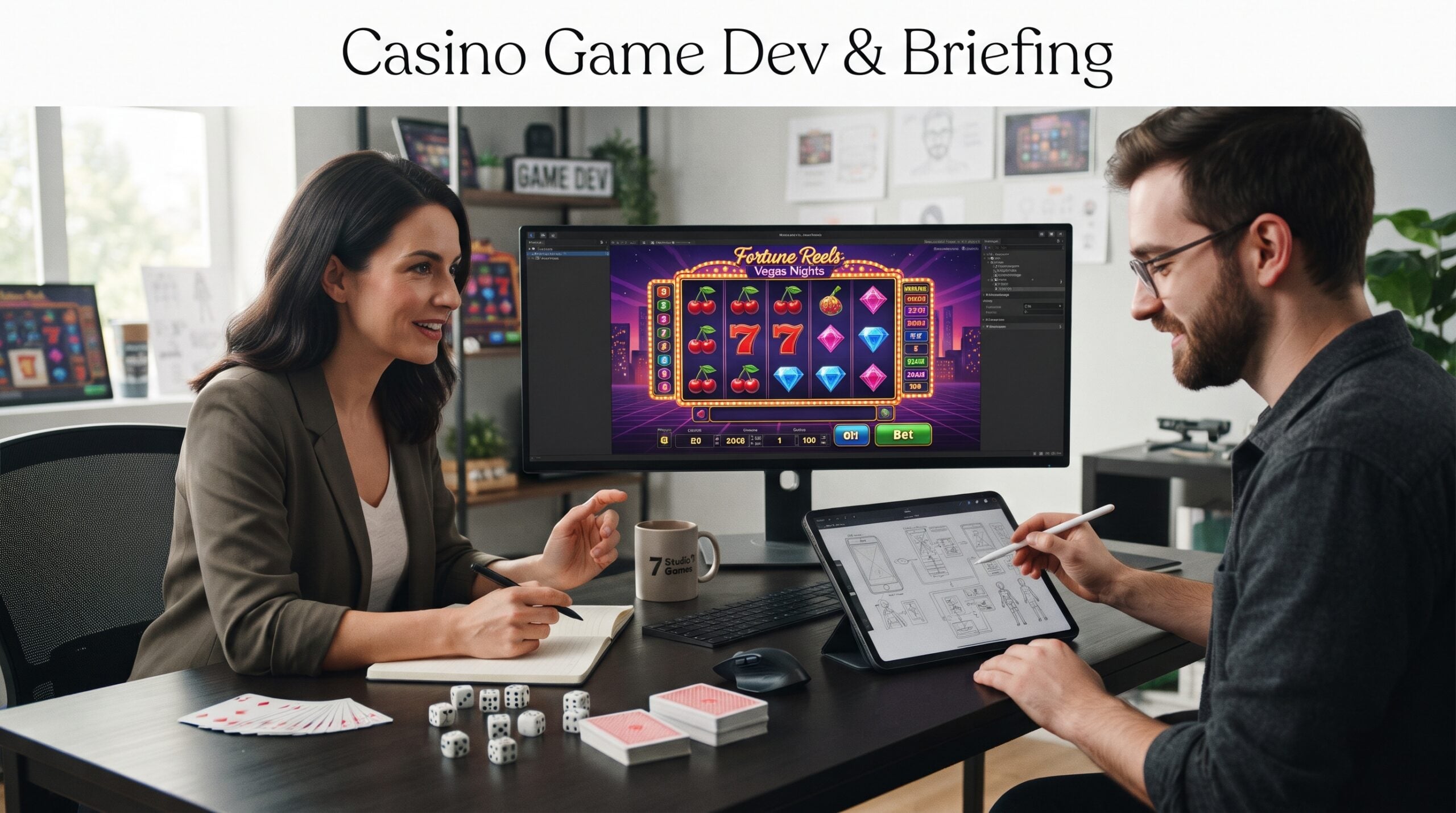
This guide lists 8 casino game app development companies, with their rates, published work, and a small test project you can ask each one for.
It then shows you what to include in a casino game brief and how to run a paid pilot over 4 weeks, so you can judge a studio on real work before you sign the full contract.
Key Takeaways
- Scope creep and budget loss affect a large share of outsourced projects, and a written brief limits both from the start.
- Concept, markets, platforms, integrations, math, art, timeline, and ownership belong in every casino game brief.
- This guide’s 8 casino game app development companies range from dedicated iGaming studios to software teams behind betting and loyalty products.
- Paid pilots of about a month test code, documentation, and communication before you commit the full budget.
- Your go or no-go call compares the pilot result with the brief, point by point.
Project Data That Makes a Pilot Worth Running
Outsourced projects rarely fail on the first day. They drift through unclear scope, shifting teams, and budgets that stretch. These 5 figures show where that drift starts:
- Scope creep hit 30% of projects on average. PMI’s Pulse of the Profession 2024 report, based on 2,588 project professionals and leaders surveyed in 2023, found the share ranged from 23% to 41% across organizations.
- Projects met their business goals 73.8% of the time. The same PMI survey measured this average across all respondents, which leaves about 1 in 4 completed projects short of what the business expected.
- Failed projects lost 25.7% of their budget on average. PMI tied that loss to projects that did not succeed, and the weakest-performing organizations in the 2024 report lost 37% of their budget on failures.
- Outsourcing budgets hold steady or grow for 80% of executives. Deloitte’s Global Outsourcing Survey 2024, drawn from more than 500 executives, reported that share planning to maintain or increase their third-party investment.
- Layoffs reached 28% of game professionals in 2 years. GDC’s 2026 State of the Game Industry survey of more than 2,300 professionals reported that rate, which makes team continuity a fair pitch question.
Shortlist of Casino Game App Development Companies for a Pilot
Every company here can take on a small, paid task before a full contract. The table sets their hourly rates and relevant published work next to a pilot task worth asking each one for.
| Company | Hourly Rate (Clutch) | Relevant Published Work | Pilot Task to Ask For |
|---|---|---|---|
| Whimsy Games | $25 to $49 | Slots, lottery and scratch card games, sweepstakes | One slot reskin |
| NipsApp Game Studios | Under $25 | Slots, poker, table games, Joy Mates hub | One table game with lab documents |
| CrustLab | $50 to $99 | KTO sportsbook and casino app | Fixed-price Discovery Sprint |
| Tecocraft LTD | Under $25 | Betting app for horse racing and football | One betting flow prototype |
| Double Coconut | $25 to $49 | Casino content for DraftKings, sports betting app | One month on a small package |
| ScaleTech | $50 to $99 | Wendy’s ordering and loyalty app | One loyalty feature |
| BlockCrunch | $25 to $49 | Brain-training app with 24 games | One smart contract proof of concept |
| APPWRK IT Solutions | Under $25 | Casino management software | One player-tracking module |
1. Whimsy Games
- Game types: Slots, crash, mines, Plinko, lottery and scratch cards, sweepstakes, real-money backgammon
- Platforms: HTML5, Unity, WebGL, native iOS and Android
- Integrations: SoftGamings, EveryMatrix, Slotegrator, Soft2Bet
- Ownership and support: Source code and IP at handover, 90 days of post-launch bug fixes
Clients work with Whimsy Games either on full-cycle projects or through a dedicated iGaming team placed inside their own pipeline.
The studio has released 15 games, including a scratch card title for a state lottery, and game budgets start from $20,000 to $40,000.
Their published projects include three themed slots. Legends of Egypt sets its reels in ancient Egypt, with pharaohs, hidden treasures, and modern slot features.
Royal Slots and Cat Slots bring slot play to mobile through casual, easy-to-learn interfaces built for a broad audience. Themed titles like these give a reskin pilot a ready starting point.
Their iGaming practice opened in 2023 on 8+ years of wider game development. On Clutch, the team holds a 5.0/5 rating from 25 client reviews.
Pilot fit: A reskin of an existing slot, which the studio turns around in about 3 weeks.
2. NipsApp Game Studios
- Game types: Video, Megaways, progressive jackpot, and Hold & Win slots, plus Texas Hold’em, Omaha, roulette, blackjack, baccarat, rummy, teen patti, and bingo
- Platforms: Android, iOS, web, and PC, built in Unity3D and Unreal Engine
For RNG slots, NipsApp prepares GLI-19 documentation, math verification, and test harnesses for the lab. Their page puts the path from math sign-off to certification at 14 to 20 weeks.
Engagements cover end-to-end game production, a white-label casino platform, or added developers. Joy Mates, one of their multiplayer builds, runs 17 games on 13 server-side engines.
Pilot fit: One table game delivered with the full lab documentation package.
3. CrustLab
- Game types: Crash and mini casino games, casino and sportsbook frontends, lottery and pool betting platforms
- Platforms: Web and mobile apps, plus 5 platforms built from scratch
- Integrations: Game aggregation for casino lobbies
- Ownership and support: Build-Operate-Transfer engagements and Sustain & Evolve maintenance
A fixed-price Discovery Sprint opens most CrustLab engagements, and ongoing development runs for at least 3 months.
The team does not rent developers by the hour. Published clients include KTO, BetMakers, BETFAN, OlyBet, and Sun International, and their fixed-pool betting platform for BetMakers runs for 20+ operators.
Pilot fit: The fixed-price Discovery Sprint, before any build starts.
4. Tecocraft LTD
- Game types: Sports betting apps for horse racing and football
- Platforms: iOS, Android, and Flutter
Gambling mobile app development sits among the main services Tecocraft lists, next to UI/UX design, real-time solutions, and QA.
Their portfolio features a betting app built for horse racing and football fans. Other published work covers wine delivery, healthcare, and industrial services, with BevFly and Revive Health Care among named clients. Projects start at $1,000, which keeps a first test task small.
Pilot fit: A clickable prototype of one betting flow, from sign-up to bet slip.
5. Double Coconut
- Game types: Slots and casual casino content, plus mobile, web, mid-core, and Web3 games
- Platforms: iOS, Android, web, and Unity
According to the studio, Double Coconut has built slots and casual casino content for DraftKings and Penn National Gaming.
A verified client review covers a sports betting product that has run since 2022, with marketing and logged-in web apps, a live leaderboard, and iOS and Android apps. Game work runs on monthly packages in three sizes, so a buyer can start with the smallest one.
Pilot fit: One month on the smallest package, scoped to a single casino feature.
6. ScaleTech
- Platforms: Web, mobile, APIs, and cloud
ScaleTech runs product engineering, product design, and dedicated teams, with 65 senior engineers and a talent pool of 800+. The co-founders left large corporations in 2017 to start the company. Clients can embed senior engineers in their own team, add staff, or hand over a full product build.
Published work includes a mobile ordering and loyalty app for Wendy’s, a public transport app for JUDU, and Debitum, a P2P lending platform for business loans.
Pilot fit: One loyalty or rewards feature built by a small embedded team.
7. BlockCrunch
- Game types: Brain-training games
- Platforms: iOS, Android, blockchain, and Web3
BlockCrunch builds mobile apps, smart contracts, and Ethereum-based products. A verified client review covers a redesign of a dating app that later won an App Store Editors’ Choice award and passed one million users.
The team also rebuilt the iOS and Android apps for an EV fast-charging network. For Memorado, they worked on a brain-training app with 24 cognitive games. Projects start at $5,000.
Pilot fit: A smart contract proof of concept for a crypto payment or provably fair feature.
8. APPWRK IT Solutions
- Game types: Sports-based games and gamification features
- Integrations: Player tracking links with IGT, Aristocrat, Konami, and Bally’s systems
APPWRK builds casino management software, including property management, player club CRM, cage management, credit management, and guest experience kiosks. Guest experience tools cover self-service kiosks, signage, and restaurant and event booking.
Their sports betting solutions update statistics automatically and include an analytics system. The company reports 2.1K completed projects over 10+ years, and published work includes Sportskeeda, a digital sports media business.
Pilot fit: One player-tracking or CRM module for a casino operator.
Brief Essentials for a Casino Game Project
A clear brief gives every studio the same problem to solve. Their estimates then become comparable, and gaps show up before money moves. Your casino game brief should cover 8 areas, each with enough detail for a studio to price the work:
Game Concept and Mechanics
Describe the game type, the core mechanic, and how a round plays from bet to result. List the bonus features you want, such as free spins, pick-and-win rounds, multipliers, or a jackpot.
Add two or three reference titles your players already know, and say what you like in each one. A studio prices a familiar mechanic faster and with fewer assumptions than a feature described only in words.
Target Markets and Licenses
Name every jurisdiction you plan to launch in during the first year, and the licenses you hold or have applied for. Rules on spin speed, stake limits, autoplay, and bonus features differ by market.
With this list, a studio can flag features that a market blocks before design starts. Your team then avoids building two versions of the same game late in the project.
Platforms, Devices, and Performance
State whether the game ships as a native iOS and Android app, an HTML5 build for operator lobbies, or both. Give the oldest devices and operating system versions your players use.
Set targets for load time and frame rate on those devices. Clear targets turn performance into a test the pilot can pass or fail.
Integrations and Back End
List your player account platform, the aggregators you work with, your remote game server if you have one, and your wallet and payment providers. Attach the API documentation your team can share under NDA.
Integration work often decides how soon a game reaches operators. A studio that sees your APIs up front can estimate that work instead of guessing it.
Math, RNG, and Certification
Give your target RTP range, volatility level, and maximum win. Name the testing lab you plan to use, such as GLI, BMM, iTech Labs, or eCOGRA, and say whether you need a certified RNG from the studio or use your own.
Ask the studio to list the math documents they will hand over for the lab. Your compliance lead can then check the package before the build starts.
Art Direction and Audio
Share mood boards, style references, and any brand guidelines. State the expected number of symbols, backgrounds, animations, and sound effects, and whether you need 2D or 3D art.
Specific counts give every studio the same scope to price. Vague art requests produce quotes that differ for reasons you cannot see.
Timeline, Budget, and Approvals
Give your target launch window and any fixed dates, such as a trade show or a market opening. Share a budget range, even a wide one, so proposals land in sizes you can use.
Name who on your side approves designs, builds, and documents, and how fast. Slow approvals stretch a schedule as much as slow development does.
Ownership, Support, and Updates
State who owns the source code, art files, and math documents after handover, and whether you plan to resell or port the game. Set out the support window you expect after launch and who pays for regulatory updates.
Put these terms in the brief as well as the contract. A studio that cannot meet them can say so before you spend time on a pilot.
Attachments That Speed Up Estimates
A few files save a round of questions for both sides. Send these with your brief:
- Reference game links or gameplay videos
- API documentation for your platform and aggregators
- Brand guidelines and any existing art
- Target markets with the license status for each one
- Your preferred pilot task, if you already have one
Running a Casino Game Pilot Week by Week
A pilot tests the studio on real work at a fraction of the full budget. A paid, time-boxed task shows what a sales call cannot. Here is one way to run it over 4 weeks:
Kickoff and a Contained Task
Choose a task small enough to finish in a month and close enough to the full project to tell you something. A reskin of an existing slot, one instant game, or a single aggregator integration all work as pilots.
In the first week, the studio confirms scope, names the team, and shares a schedule. A strong response to your brief comes back with clarifying questions.
First Build and Code Access
By the second week, ask for a playable build on your target devices and access to the code repository. Early access shows how the team writes, documents, and commits code.
Test the build on the oldest phone your players use. Frame drops or long load times at this stage show where performance work will land in the full project.
Documentation and Math Review
In the third week, review the documents a lab would need: the math model, RTP calculations, and game rules. Your compliance lead or an external math reviewer can check them against your target markets.
Progress reports matter as well. Clear status updates, logged issues, and early flags about delays show how the full project will run.
Go or No-Go Decision
At the end of the pilot, compare the result with your brief on scope, quality on device, documentation, and communication. Score each studio on the same points if you ran more than one pilot.
A go decision moves the same team into the full build with known strengths. With a no-go, you lose one small project, and a pilot contract that assigns code ownership to you leaves working code to take elsewhere.
Conclusion
A casino game contract commits your budget, your launch date, and your players’ first impression to one studio. When the fit is wrong, the cost shows up in rework, delays, and features that never reach a lobby.
Let the project type set the pilot. For a slot portfolio, ask a casino game app development studio for one reskin. An instant game line calls for a single title, and a platform launch calls for one integration. Each pilot answers the question your full project depends on.
