

Search for healthcare workforce engagement and most results are about nurses. Shift equity, clinical scheduling, credentialing, and unit-level staffing dominate the category, and those are real problems. They are a different problem from the one facing the patient access team answering the phone.
Quick answer: Workforce engagement management for healthcare is the software layer that forecasts patient contact center volume, builds agent schedules, evaluates the quality of patient conversations, and coaches agents after the conversation. It differs from clinical workforce management, which staffs nurses and providers.
Key takeaways
- Healthcare WEM and clinical workforce management are separate categories. Clinical tools staff nurses; WEM staffs specialized contact center agent to assist with patient inquiries and improve conversations.
- The patient access contact center is the front door, and hold times there shape patient experience before any direct care happens.
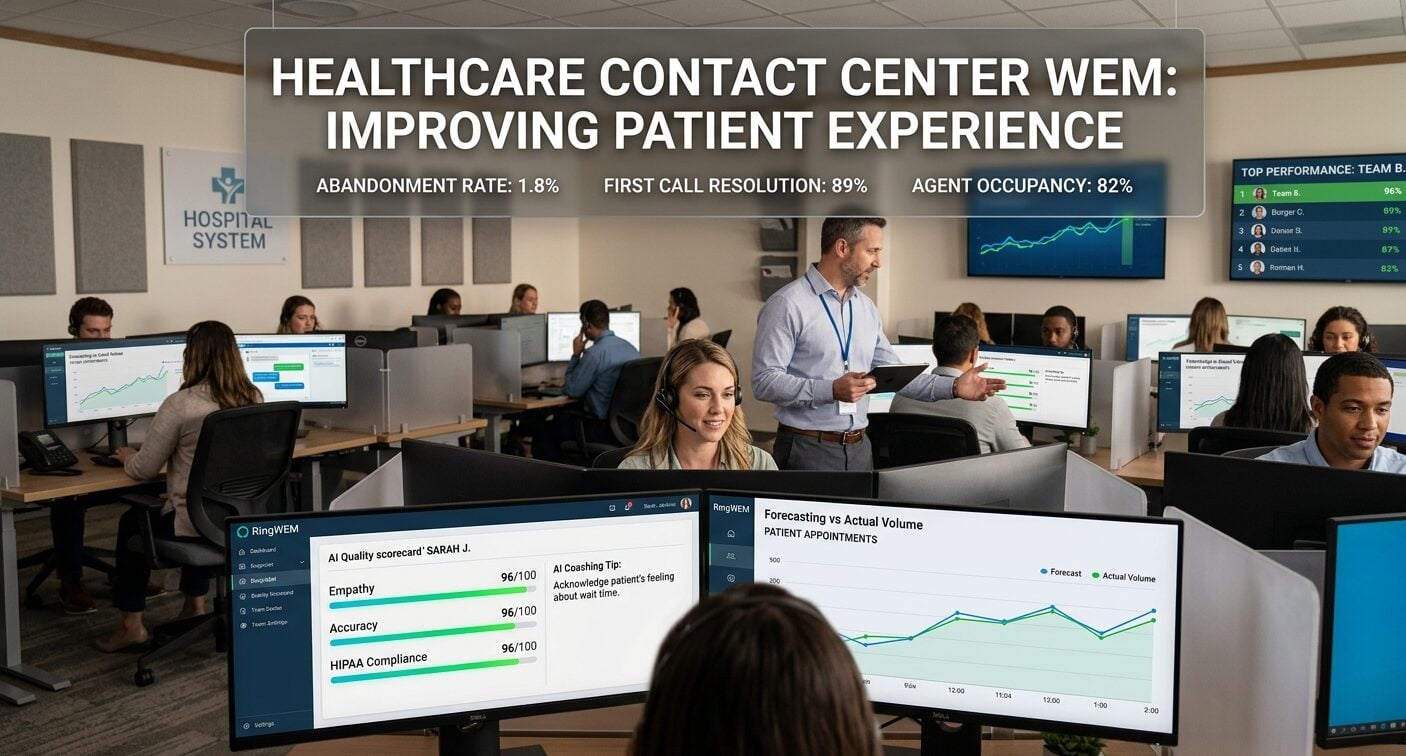
- AI quality management scores every patient conversation for empathy, accuracy, and appropriate handling of protected health information, rather than the small sample of a manual review.
- Agent forecasting matched to demand reduces the abandonment rates that push patients to leave voicemails or simply give up.
- Spreadsheet workforce management misses burnout because adherence, occupancy, and handle time surface the warning signs that an agent is at risk of resigning.
- BAA scope, not vendor name, is the first question, since coverage is granted per service and standard SMS is often excluded.
What is workforce engagement management for healthcare?
Workforce engagement management for healthcare is a set of contact center technologies covering forecasting, scheduling, quality management, coaching and interaction analytics. These solutions apply to the teams handling patient calls, messages, and requests.
WEM sits in the contact center and matches agents to patient calls, chats, and emails. Those conversations can include appointment booking, covering referrals, insurance verification, billing questions, prior authorizations, and more.
The best healthcare WEM solutions must assist in predicting how much contact volume is coming and scheduling for the kind of expertise each conversation will take to resolve.
AI scores every conversation rather than a sample, which surfaces both coaching needs and early signs of burnout before they turn into attrition and longer hold times.
Run together, those capabilities compound: patients reach someone equipped to resolve the issue on the first call, agents work schedules built from real demand rather than guesswork, and health system leaders can see what each staffing decision bought in both service and spend.
Why does patient access need its own WEM layer?
Contact center performance is the first experience most patients have with a health system, and patients and providers do not see it the same way.
In Experian Health’s 2026 State of Patient Access study, 46% of providers believed access had improved while only 18% of patients agreed, and 64% of providers said staffing shortages were reducing access. That staffing gap can be a WEM problem, not a clinical one.
An abandoned scheduling call is frequently a delayed appointment, and access has already failed before anyone reaches a clinician.
The costlier failure is quieter: an insurance dispute reaches a representative who cannot resolve it, gets escalated, and passes between specialists, with each hop billing expensive agent time against a question that still has no answer. Neither failure shows up in a provider’s view of access, which is part of why patients score it so much lower.
How does WEM improve patient experience?
Forecasting that matches patient calling patterns
Patient contact volume can vary greatly from day to day. Monday mornings, post-holiday periods, flu season, and the days after a statement drop all produce predictable spikes that generic staffing models can miss.
AI forecasting that tests multiple models against a health system’s own contact volume history ensures the right number and type of agents are in place.
Quality scoring on every patient conversation
AI quality management evaluates all interactions against a scorecard rather than a small sample. In healthcare, that scorecard carries a unique type of weight, covering empathy on difficult calls, accuracy on clinical instructions, correct identity verification, and appropriate handling of protected health information.
RingCentral’s AI quality management adds a compliance view to AI interaction analytics that automatically flags sensitive data under HIPAA, PCI DSS, and GDPR, with severity filters that surface high-risk interactions first. That turns compliance monitoring from a sampling exercise into full coverage.
Coaching aimed at the calls that went wrong
Once every interaction is scored, supervisors can address conversations directly and coach on evidence rather than impression.
For patient access teams, where one poorly handled call by an agent can generate a complaint that reaches the executive level, this changes what supervisors spend their time on.
RingCentral customer MedCare Equipment Company offers a concrete example. For that team, the gain came in supervisor review time: call review dropped from 25 minutes to 2, a 92% time saving that freed supervisors to coach instead of listen.
Catching burnout before it becomes attrition
With WFM software, a contact center knows exactly which agents are staying on task and provides multiple shift options, such as fixed, floating, and split, to help agents improve their desired work-life balance.
In addition, contact centers can even leverage WFM software to let agents bid on schedules and highly desired time off days.
They can even prioritize specific groups to bid first, such as top performers or senior agents, to help with improving agent morale, performance, and tenure duration.
Combining WFM with engagement analytics provides a full picture that helps to keep agent morale high.
Staffing the right skill, not just the right headcount
Healthcare contact centers employ a variety of specialized agents with very different cost bases: general representatives, billing and revenue cycle specialists, prior authorization staff, bilingual agents, and registered nurses.
Overstaffing when specialized agents aren’t needed can increase overhead costs, whereas understaffing may slow resolution times and degrade patient satisfaction.
Workforce engagement management solves this by widening what the forecast is built from. Telephony history records which queue a call landed in. Interaction analytics records what the caller actually needed, and the gap between those two is where specialist demand hides.
Feeding contact drivers and intent-level handle times back into planning gives a health system a truer read on how many specialized agents should be staffed for a given week.
Which WEM platforms fit healthcare contact centers?
The vendor shortlist barely changes between healthcare and any other contact center. What changes in healthcare are which questions you ask before signing: whether the vendor signs a business associate agreement and which services and channels it covers, whether quality scoring can evaluate identity verification and PHI handling rather than just tone, and whether forecasting accurately reflects skill scheduling demands rather than only raw call counts.
- RingCentral (RingWEM). RingWEM is RingCentral’s AI workforce engagement suite, reading from the interaction data RingCX already holds rather than records imported from a separate system. Because scoring runs across every interaction, identity verification and PHI handling can be written as scorecard criteria instead of caught by spot-check. Forecasting and scheduling sit on that same data, and one agreement covers the engagement layer and the contact center underneath it.
- NICE. Deep forecasting and quality management with a large healthcare reference base, suited to organizations with a formal workforce planning function. Healthcare-specific scorecards require configuration rather than arriving prebuilt.
- Verint (including Calabrio ONE). Verint and Calabrio now operate as one company under the Verint name, with Calabrio ONE continuing as a product brand. Verint’s TimeFlex bot lets agents change schedules without degrading service levels, a direct retention lever in high-turnover access roles. Roadmap consolidation following the combination is still underway.
- Genesys. A strong fit for health systems already standardized on Genesys Cloud CX, with forecasting depth to match. Implementation requires technical expertise and longer timelines and generally a partner.
- Aspect. Workforce management with healthcare-specific guidance on forecasting and equitable shift assignment. Quality management comes from elsewhere. Every vendor here needs a signed BAA before PHI reaches recordings or transcripts, and coverage is granted per service rather than per company.
FAQs
How is healthcare WEM different from clinical workforce management?
Clinical workforce management staff nurses and providers by unit and shift. WEM staffs and coaches the contact center teams for a healthcare company handling calls, messages, and requests. The forecasting inputs and quality criteria are entirely different.
Does WEM software need to be HIPAA compliant?
Yes, if it records, transcribes, or analyzes conversations containing protected health information, which quality management and interaction analytics do by design. It requires a signed business associate agreement and confirms which specific services and channels it covers.
How does WEM reduce patient wait times?
Better forecasting makes agents available with the right skills needed for expected contact volumes, which lowers speed of answer and abandonment. Solutions such as shift bidding and split shifts improve the agent experience and reduce staffing turnover.
Can WEM help with contact center staff burnout?
Yes, it enables contact centers to provide an array of staffing options that allow agents to achieve their desired work-life balance. From shift bidding to split shifts, agent staffing solutions exist that place more power in the hands of agents so they are less likely to leave. In addition, engagement analytics such as adherence can assist with ensuring agents are staying on task and indicate burnout warning signs so they can be addressed quickly
Is WEM worth it for a small patient access team?
Yes, the quality and coaching layer pays back at any size once every interaction is scored. Being able to staff up and down quickly with modern workforce management, as well as full visibility into agent performance and attendance, are worthwhile solutions that help improve the bottom line.
Improve patient experience with healthcare WEM
The patient access contact center has moved from a back-office function to the operational front door, and it is measured accordingly.
Metrics such as speed of answer and call abandonment can now be correlated directly to revenue cycle performance. WEM for healthcare contact centers is how this data is managed rather than just reported.
